Receiving a diagnosis of degenerative disc disease can feel alarming. The word degenerative implies an irreversible and worsening process. The word disease suggests something serious and progressive. And for many patients in Dubai who receive this diagnosis after an MRI scan, the immediate concern is that their spine is deteriorating in a way that cannot be stopped.
The reality is more nuanced and considerably more hopeful than the name suggests.
After more than 36 years of clinical practice treating spinal conditions, first across the United States and now here in Dubai, degenerative disc disease is one of the most frequently misunderstood diagnoses I discuss with patients. Understanding what it actually means, what it does not mean, and what evidence-based care actually involves is the starting point for any meaningful conversation about managing it effectively.
This article is written for Dubai residents who have received a degenerative disc disease diagnosis and want clear, honest answers about what is happening in their spine and what their realistic options are.
What Degenerative Disc Disease Actually Is
Degenerative disc disease is not strictly a disease in the traditional sense. It is a term used to describe the natural age-related changes that occur in the intervertebral discs of the spine over time.
The intervertebral discs are the fibrocartilaginous cushions that sit between each vertebra of the spine. They serve as shock absorbers, allow spinal movement, and maintain the spacing between vertebral bodies that creates the foraminal openings through which spinal nerve roots exit the spine. Each disc is made up of a tough outer ring called the annulus fibrosus and a soft gel-like centre called the nucleus pulposus.
From early adulthood onward, the intervertebral discs undergo gradual changes as part of the normal ageing process.
The nucleus pulposus loses hydration over time, reducing the disc's ability to absorb and distribute compressive forces. The annulus fibrosus develops small tears and fissures. The overall disc height reduces as the nucleus loses volume. These changes are visible on MRI and are collectively described as disc degeneration.
The critical point — and the one most frequently missing from the conversation when patients receive this diagnosis — is that disc degeneration is an extremely common finding on MRI in adults without any back pain at all. Studies consistently show that significant disc degeneration is visible on imaging in a large proportion of adults in their thirties, forties, and beyond who have no spinal symptoms whatsoever.
Degenerative disc disease is therefore not synonymous with pain. Many people with significant disc degeneration on imaging have no symptoms. Many people with significant back pain have minimal disc degeneration on imaging. The relationship between the imaging findings and the clinical presentation is more complex than a simple cause-and-effect relationship.
What Causes Disc Degeneration to Become Symptomatic
If disc degeneration is a normal ageing process that many people experience without pain, why do some people with this finding on MRI develop significant symptoms while others do not?
The answer lies in the mechanical environment of the spine rather than in the degree of disc degeneration itself.
Cumulative Mechanical Loading
The intervertebral discs of the lumbar and cervical spine are subjected to compressive and shear forces throughout every waking hour. Sustained sitting, prolonged driving, heavy lifting, and the postural patterns of desk-based work all create patterns of asymmetrical loading that accelerate the degenerative process beyond what ageing alone would produce and create the mechanical conditions under which degenerated discs become symptomatic.
Dubai's working population is particularly exposed to these cumulative loading patterns. Eight to twelve hours of desk work, significant daily driving on Sheikh Zayed Road and across the city's arterials, and the common pattern of sedentary weekdays followed by intense weekend physical activity creates a profile of spinal loading that few discs can sustain indefinitely without eventually becoming symptomatic.
Reduced Disc Height and Nerve Root Tension
As disc height reduces with degeneration, the foraminal spaces through which nerve roots exit the spine narrow. This can produce intermittent or sustained nerve root irritation that generates not just back pain but radiating symptoms in the leg or arm depending on the spinal level affected.
Facet Joint Changes
As disc height reduces, the facet joints at the posterior aspect of each spinal segment bear increased load. Over time this produces facet joint arthritic changes that contribute to the pain pattern associated with degenerative disc disease, particularly the characteristic morning stiffness and pain with sustained standing or walking that many patients describe.
Secondary Muscle Guarding
Disc degeneration and the associated facet joint changes produce altered movement patterns and chronic protective muscle guarding that becomes a significant pain driver in its own right. The primary degenerative changes and the secondary muscle response together create the complex pain picture that most degenerative disc disease patients experience.
Degenerative Disc Disease in Dubai: A Specific Lifestyle Challenge
What I observe repeatedly in clinical practice in Dubai is that the city's professional and lifestyle demands create conditions that accelerate both the development and the symptomatic expression of disc degeneration beyond what would be expected from ageing alone.
The desk-working population of Dubai's major business districts spends more sustained hours in sitting postures that compress the posterior disc walls and load the facet joints asymmetrically than equivalents in most other cities. The commuting population adds further hours of sustained spinal loading in vehicle seats that frequently provide inadequate lumbar support.
The gym-going population, which is large and motivated in Dubai, frequently trains with movement asymmetries and spinal mechanics that place disproportionate load on already compromised spinal segments.
Add to this the fact that many Dubai residents carry significant accumulated postural dysfunction from years of desk work before any physical symptoms appear, and it becomes clear why degenerative disc disease is so commonly seen in relatively young working professionals across the city.
What Evidence-Based Treatment for Degenerative Disc Disease Involves
The most important clinical message I can share with any patient who has received a degenerative disc disease diagnosis is this: the degenerative changes visible on imaging cannot be reversed, but the symptoms they produce can be very significantly reduced and in many cases eliminated through properly structured conservative care.
The goal of evidence-based treatment for degenerative disc disease is not to change what is visible on the MRI.
It is to optimise the mechanical environment of the degenerated spinal segment so that it is no longer producing pain, to restore the normal movement and muscle activation patterns that have been disrupted by the chronic pain response, and to equip the patient with the knowledge and strategies to protect their spine from further symptomatic deterioration.
Chiropractic Spinal Manipulation and Mobilisation
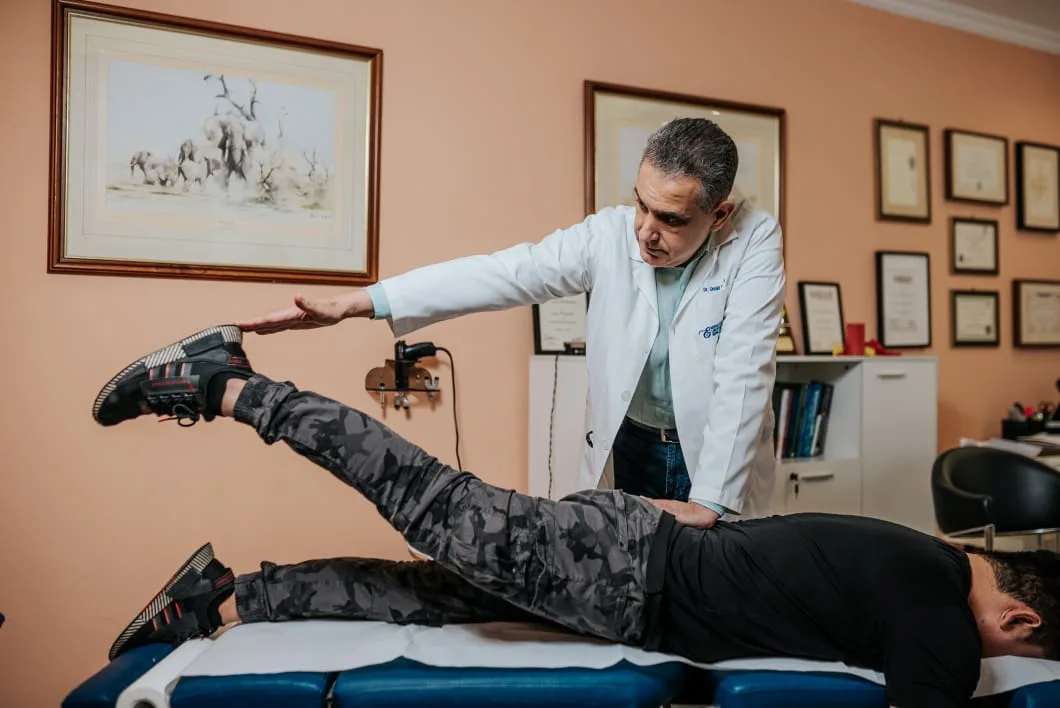
Chiropractic care for degenerative disc disease focuses on restoring normal joint mobility to the affected and adjacent spinal segments, reducing the protective muscle guarding that has developed in response to the chronic pain, and improving the overall mechanical function of the lumbar or cervical spine. Specific manipulation and mobilisation techniques are selected based on the individual patient's clinical presentation, the degree and distribution of the degenerative changes, and the presence of any associated nerve root involvement.
The evidence base for chiropractic care in degenerative disc disease is consistent with that for mechanical back pain more broadly — spinal manipulation produces clinically meaningful improvements in pain and function for the majority of patients when applied appropriately and based on accurate clinical assessment.
You can read more about the specific chiropractic treatments available at the clinic at drgerrydxb.com/chiropractic-care/
Non-Surgical Spinal Decompression
For patients whose degenerative disc disease is associated with disc herniation, foraminal narrowing, or nerve root compression producing radiating arm or leg symptoms, non-surgical spinal decompression provides a specific therapeutic approach that addresses the nerve root component of the presentation.
Computer-controlled decompression therapy creates precise negative intradiscal pressure that reduces nerve root compression, promotes fluid exchange within the damaged disc tissue, and can produce meaningful improvements in radicular symptoms that have not responded to other conservative approaches. More information on this treatment is available at drgerrydxb.com/slip-disc-treatment-dubai/
Rehabilitation and Postural Correction
Degenerative disc disease is a condition where the quality and consistency of the patient's own movement habits and physical practices have a significant impact on long-term outcomes. Targeted rehabilitation directed at restoring spinal stability, correcting the postural patterns that have accelerated the degenerative process, and rebuilding the muscle endurance that protects the degenerated spinal segments from further symptomatic loading is an essential component of lasting improvement.
Lifestyle and Ergonomic Modification
The ongoing mechanical inputs that drove the symptomatic expression of the degenerative changes need to be addressed alongside the clinical treatment. Workstation setup, movement habits during the working day, training modifications, sleep positioning, and activity modification during symptomatic periods are all addressed as part of a comprehensive management plan.
What Degenerative Disc Disease Does Not Mean
There are several common misconceptions about degenerative disc disease that deserve direct clarification.
It does not mean your spine is collapsing. Disc degeneration is a normal ageing process that affects the vast majority of adults over time. The majority of people with significant degenerative changes on imaging live active, pain-free lives.
It does not automatically mean surgery. Surgery for degenerative disc disease is appropriate in a specific and limited set of presentations — primarily where there is severe nerve compression producing progressive neurological deficit or where all appropriate conservative care has genuinely failed over an adequate trial period. For the majority of degenerative disc disease presentations, conservative care is the appropriate first-line approach and produces very good outcomes.
It does not mean your pain will inevitably get worse. Many patients with symptomatic degenerative disc disease experience significant and lasting improvement with appropriate conservative care and ongoing attention to spinal health habits. The trajectory is not predetermined.
It does not mean you cannot exercise. Movement and appropriate exercise are protective for the degenerated spine, not harmful. The specific exercises and activities that are most beneficial depend on the individual patient's presentation and are guided by clinical assessment.
When to Seek Assessment for Degenerative Disc Disease
If you have received a degenerative disc disease diagnosis on MRI and are experiencing back or neck pain, seeking professional assessment from an experienced clinician is the appropriate starting point for understanding your specific clinical situation and developing a management plan.
A thorough clinical assessment goes beyond reviewing the MRI report. It examines how the degenerative changes are mechanically affecting your spine, identifies the specific factors that are driving your symptoms, assesses for any nerve root involvement, and evaluates the postural and movement patterns that are contributing to the symptomatic expression of the degenerative changes.
If your degenerative disc disease is associated with radiating arm or leg pain, numbness or tingling in the limbs, or progressive muscle weakness, professional assessment is particularly important. These features suggest nerve root involvement that benefits from specific treatment directed at the neural component of the presentation.
Frequently Asked Questions About Degenerative Disc Disease
Q: Is degenerative disc disease serious?
Degenerative disc disease describes normal ageing changes in the spinal discs. Many people with significant degenerative changes on MRI have no pain at all. When symptoms are present, they respond well to appropriate conservative care in the majority of cases.
Q: Can degenerative disc disease be cured?
The degenerative changes visible on imaging are not reversible. However, the symptoms that degenerative disc disease produces can be very significantly reduced and in many cases eliminated through properly structured conservative care and appropriate lifestyle modification.
Q: Does degenerative disc disease get worse over time?
The degenerative process continues with ageing, but symptom severity does not necessarily track with the degree of degeneration visible on imaging. Many patients experience significant and lasting improvement in symptoms with appropriate management even as the underlying degenerative process continues at its natural pace.
Q: Can I exercise with degenerative disc disease?
Yes. Appropriate movement and exercise are beneficial for the spine affected by degenerative disc disease. The specific activities that are most appropriate depend on your individual clinical presentation. A proper assessment helps clarify which activities to pursue and which to modify during symptomatic periods.
Q: What is the difference between degenerative disc disease and a herniated disc?
Degenerative disc disease refers to the age-related changes in disc structure, including loss of hydration and disc height reduction. A herniated disc refers to a specific event where disc material pushes through the outer wall and compresses nearby nerve structures. The two conditions are related — degenerative discs are more susceptible to herniation — but they are distinct clinical findings that may require somewhat different treatment approaches.
Q: Do I need surgery for degenerative disc disease?
In the majority of degenerative disc disease cases, surgery is not required. Conservative care including chiropractic treatment, spinal decompression where indicated, rehabilitation, and lifestyle modification produces good outcomes for most patients. Surgery is considered when there is significant neurological compromise or when appropriately structured conservative care has genuinely failed.
Taking the Next Step
If you are living or working in Dubai and have received a degenerative disc disease diagnosis — or are experiencing back or neck pain and want to understand whether disc changes may be contributing — a comprehensive clinical assessment is the right starting point.
As a DHA licensed chiropractor in Dubai with over 36 years of clinical experience and dual board certification in Chiropractic Orthopedics and Neuromusculoskeletal Medicine, I provide assessments that go beyond reviewing imaging reports to understand the specific mechanical factors driving each patient's symptoms and develop a treatment plan directed at lasting improvement rather than symptom management alone.
The clinic is located in Umm Suqeim 2, open seven days a week from 8:30am to 7:00pm. No referral is required.
To book your assessment or learn more about how chiropractic care can help with degenerative disc disease in Dubai, visit drgerrydxb.com or call +971 52 239 3099.