Every expanding UK company faces the same dilemma: hire a freelancer for the upcoming sprint or commit to a long-term development team. Get the call wrong and the cost is rarely just wasted budget — it is a missed launch window, patchy documentation, and a codebase nobody left behind fully understands.
From past 2-decades, RSK Business Solutions has established dedicated development team UK engagements and short-term freelancing assignments for UK clients, and the truth is that neither model is universally appropriate. The choice is based on how long the project will take, how much institutional knowledge the codebase must maintain, and how much daily supervision the company can actually provide.
This guide sets out where each model earns its place, the UK-specific factor — IR35 — that changes the maths, and the mistakes that turn a sensible hiring decision into an expensive one.
Freelancers and Dedicated Teams: What Actually Separates Them
A freelancer is hired for a defined piece of work — a feature, an integration, a fix — and moves on once it ships. A dedicated development team is assembled to work exclusively on one product on an ongoing basis, embedded in the business's processes, roadmap and day-to-day communication. The freelancer model buys hours; the dedicated team model buys continuity.
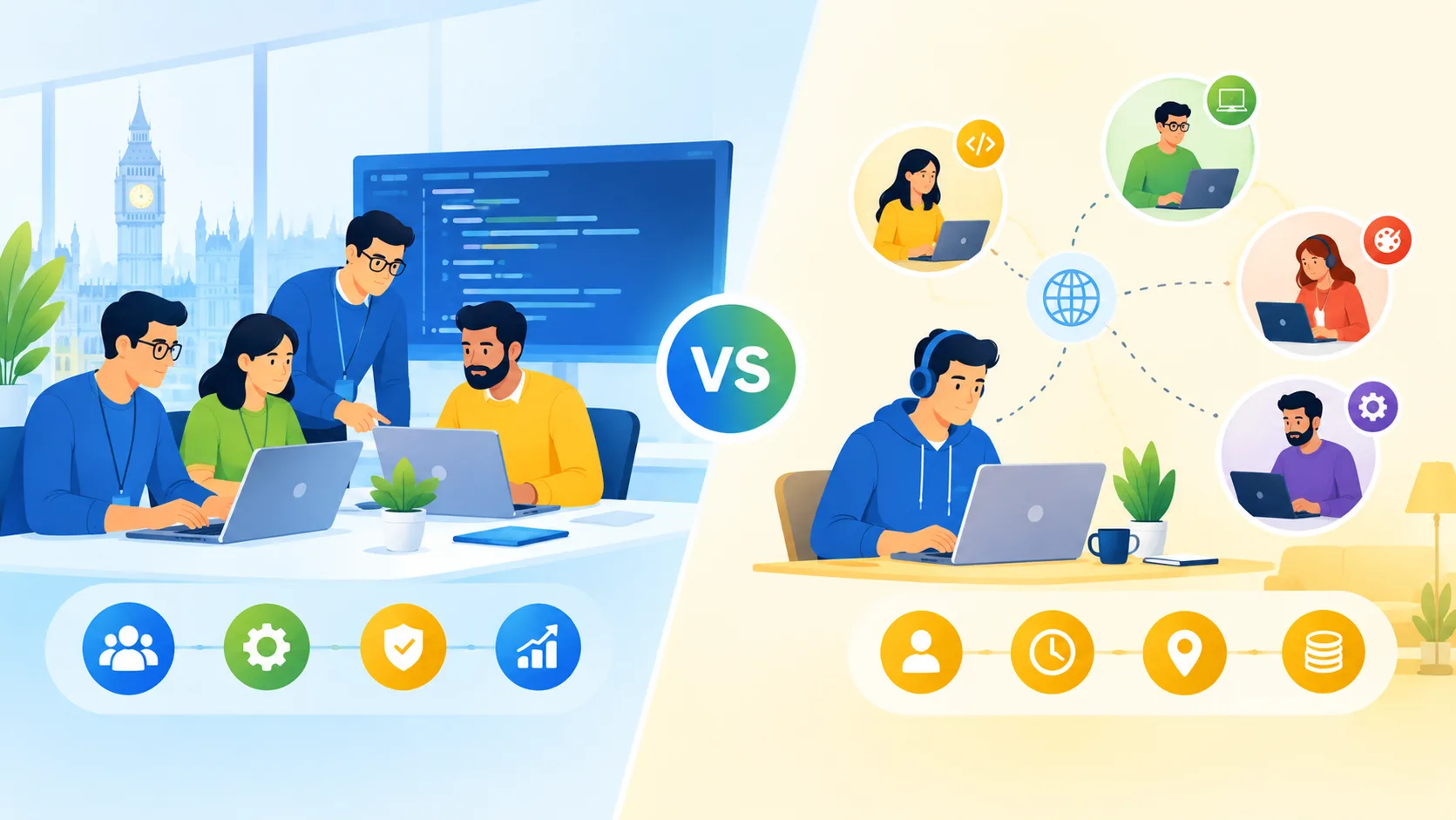
Freelancer vs Dedicated Team
FactorFreelancerDedicated Development TeamBest suited toShort, well-defined tasksOngoing product developmentOnboardingFast, but repeats with every new hireOne-off, then compounds over timeKnowledge retentionLeaves with the freelancerStays with the businessManagement overheadLow per engagement, high across several freelancersHandled by the provider's team leadCost structurePay per hour or day workedFixed, predictable monthly team costScalingHard to scale predictablyRoles added or removed as the roadmap shiftsIR35 exposureSits with the hiring businessSits with the outsourcing providerWhen a Freelancer Is the Right Call
- For UK businesses that simply want to hire freelance developers UK for a single, well-defined job — a one-off integration, a design sprint, a security audit — a freelancer is exactly the right, low-commitment choice.
- The in-house team already owns the product and just needs specialist help for a few weeks.
- Budget needs to flex month to month rather than commit to a fixed team cost.
- The work does not depend on deep, ongoing knowledge of the wider codebase.
When a Dedicated Team Earns Its Keep
- The roadmap runs for months or years, not weeks.
- The product needs someone who still remembers why a decision was made six sprints ago.
- Delivery depends on more than one skill — front-end, back-end, QA, DevOps — working as a unit rather than a string of individual contractors.
- The business wants a single point of accountability instead of managing several separate freelancer relationships.
RSK Business Solutions builds this second model regularly — one example is a dedicated .NET and SQL development engagement for a UK-based cybersecurity firm specialising in managed security services and governance, risk and compliance for enterprise clients. Rather than working as an outside vendor, our specialists were embedded directly into the client's existing engineering team, adapting to shifting priorities across the software development lifecycle — exactly the kind of continuity a rotating cast of freelancers struggles to guarantee.
The IR35 Question UK Businesses Can't Skip
Since the off-payroll working regulations changed on April 6, 2021, medium and large private-sector enterprises in the UK have been responsible for determining a contractor's IR35 status themselves, rather than leaving it to the contractor. If that determination is incorrect for a freelancer who is actually functioning as an employee, HMRC may prosecute the hiring company for unpaid tax and National Insurance.
Layering several long-term freelancers on top of each other multiplies that exposure with every relationship.
A dedicated team supplied by an outsourcing partner sits outside this determination process altogether — the business is buying a service, not engaging an individual, so the IR35 status question does not arise in the same way. For UK businesses already juggling multiple freelance contracts, that alone is often reason enough to consolidate into a dedicated team.
Common Mistakes UK Businesses Make
- Hiring a freelancer for a 12-month project and then re-hiring and onboarding every few months when availability changes.
- Assuming a dedicated team costs more, without pricing in the recruitment, management time and IR35 risk of running several freelancers in parallel.
- Treating a dedicated team like a single freelancer — no defined roadmap, no product owner, so the team has no direction to work against.
- Skipping reference checks and a trial sprint before committing to either model.
How RSK Business Solutions Builds Dedicated Teams
RSK Business Solutions, headquartered in Hildenborough, Kent, and Companies House-registered since 2009, runs its dedicated team model around a simple principle: UK-based leadership sets direction and holds accountability, while a development centre near Delhi delivers the day-to-day engineering — keeping cost lower than an equivalent UK-only hire without losing oversight. It is, in effect, an IT staff augmentation UK model: teams, from a single engineer to a full delivery pod, typically onboard within days rather than weeks and can scale up or down as the roadmap changes, including a white-label option for agencies that want the delivery to sit invisibly behind their own brand.
RSK Business Solutions, headquartered in Hildenborough, Kent, and Companies House-registered since 2009, operates a dedicated team model based on a simple principle: UK-based leadership sets direction and holds accountability, while a development centre near Delhi delivers day-to-day engineering — keeping costs lower than an equivalent UK-only hire while maintaining oversight. In essence, it is a UK model for IT staff augmentation: teams, ranging from a single engineer to an entire delivery pod, can scale up or down as the roadmap changes, and there is a white-label option for agencies that want the delivery to blend in seamlessly with their own brand. Teams typically onboard within days rather than weeks.
Frequently Asked Questions
1. How quickly can a dedicated development team be onboarded?
RSK Business Solutions typically onboards a dedicated team within days, since engineers are already vetted and available rather than sourced from scratch for each new engagement.
2. Does IR35 apply when working with a dedicated team from an outsourcing partner?
No. A dedicated team is provided as a service rather than as an individual contractor, therefore the IR35 status assessment that applies to freelancers does not apply.
3. Can a business start with a freelancer and move to a dedicated team later?
Yes. Many RSK Business Solutions clients begin with a single freelance specialist and scale into a dedicated team as the roadmap and workload grow, without changing delivery partner.
Conclusion
The choice between a freelancer and a dedicated development team is not about which model is better — it is about matching the model to the shape of the work. Short, well-defined tasks still make freelancers the sensible option; ongoing product roadmaps, multi-skill delivery and long-term knowledge retention are where a dedicated team, or a broader IT staff augmentation UK arrangement, pays for itself, IR35 exposure included. RSK Business Solutions has run both models long enough to make that call on the evidence, not on habit.
Businesses weighing up a hiring model for their next project can book a free consultation with RSK Business Solutions to work out, model by model, which one actually fits the roadmap.