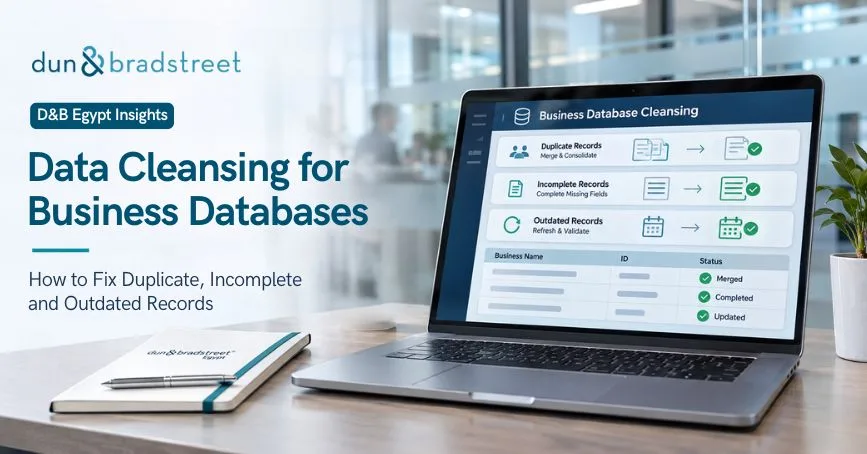
Business databases are only as valuable as the information they contain. When customer records are duplicated, company details are incomplete, or contact information becomes outdated, even well-designed systems can produce unreliable results. These data quality issues affect sales, marketing, financial assessments, compliance activities, and everyday business decisions.
As organisations collect information from multiple sources, maintaining accurate and consistent records becomes increasingly challenging. Data cleansing helps businesses identify and correct errors, remove unnecessary duplication, and keep information relevant.
A structured approach to database cleansing can improve operational efficiency, strengthen reporting accuracy, and support more confident decision-making.
What Is Data Cleansing?
Data cleansing, also known as data cleaning, is the process of identifying, correcting, standardising, and removing inaccurate, incomplete, duplicated, or outdated information from a database.
It involves reviewing existing records, detecting inconsistencies, validating information against reliable sources, and establishing rules that maintain data accuracy.
For example, a customer database may contain the same company under different names, missing identification details, or addresses that have changed. Without proper data cleansing, these inconsistencies can affect how businesses identify, evaluate, and communicate with customers.
Effective data hygiene ensures that business information remains accurate, consistent, complete, and suitable for its intended use.
Why Do Business Databases Develop Data Quality Problems?
Business databases frequently contain inaccurate data because information is collected, entered, and updated through different systems and processes.
Common causes include:
- Manual entry errors: Spelling mistakes, incorrect numbers, and inconsistent formatting.
- Multiple data sources: CRM platforms, financial systems, and external databases may contain overlapping records.
- Outdated information: Companies change addresses, contact details, ownership structures, and operational status.
- Incomplete records: Important fields may be missing during customer onboarding or data imports.
- Inconsistent standards: Different departments may follow different naming conventions or data entry procedures.
When these issues accumulate, organisations may struggle to establish a reliable view of customers, suppliers, and business partners.
1. Identify and Remove Duplicate Records
Duplicate records are among the most common problems affecting business databases.
A company might appear multiple times because its name has been entered differently, such as using abbreviations, alternative spellings, or variations in legal entity names.
Duplicate data removal begins with identifying records that potentially refer to the same organisation.
Businesses can compare information such as company registration numbers, business addresses, tax identifiers, and other unique identification details.
Once duplicates are identified, records should be reviewed and merged carefully to preserve relevant information.
For example, one record may contain updated contact information while another includes important transaction history. Simply deleting one entry could result in valuable data loss.
Automated matching tools can support duplicate detection, but uncertain matches should receive additional verification before records are combined.
2. Complete Missing Business Information
Incomplete records reduce the usefulness of customer and supplier databases.
Missing company identifiers, addresses, industry classifications, or contact details can make it difficult to verify businesses and conduct reliable risk assessments.
Organisations should begin by identifying which fields are essential for their operations.
These may include:
- Registered company name and business identification number
- Registered address and operating location
- Industry classification and business activity
- Contact information
- Ownership and corporate structure details
Missing information can then be verified and supplemented using reliable internal records, official registers, or appropriate business information providers.
However, data validation is essential. Businesses should not fill missing fields using assumptions or unverified information simply to make records appear complete.
3. Update Outdated Company Records
Business information changes continuously. Organisations relocate, restructure, change ownership, expand into new sectors, or cease operations.
Without regular updates, customer databases gradually become less reliable.
Customer database cleaning should therefore include periodic checks of important business details against authoritative or trusted sources.
Higher-risk records may require more frequent reviews, particularly when information supports credit decisions, supplier approvals, or compliance assessments.
Businesses can also establish event-based updates when significant changes occur, such as ownership changes, returned communications, or changes in company status.
This approach supports ongoing data quality improvement rather than relying entirely on occasional database clean-up exercises.
4. Apply Consistent Data Standardisation
Data standardisation ensures that information follows consistent formats and definitions across business systems.
Without standardisation, database searches, reporting, and automated matching can produce incomplete results.
A data standardisation process should establish clear conventions for important fields while preserving original legal names and identifiers where necessary.
Consistent formatting makes records easier to compare, integrate, and analyse across departments.
5. Introduce Data Validation Rules
Data cleansing becomes more effective when organisations prevent new errors from entering their databases.
Data validation rules help ensure that information meets defined quality requirements before it is accepted into a system.
These controls may include mandatory fields, acceptable formats, identifier checks, duplicate warnings, and verification procedures.
For example, a CRM system can flag a potentially duplicate company before a new record is created.
Validation at the point of entry reduces repetitive corrections and strengthens long-term data hygiene.
6. Monitor Data Quality Continuously
Database cleansing should not be treated as a one-time project.
Organisations need ongoing monitoring to measure whether records remain accurate, complete, and consistent.
Useful data quality indicators include duplicate record rates, missing-field percentages, validation failures, and the proportion of records reviewed within a defined period.
Clear ownership of data quality responsibilities also helps ensure that errors are addressed promptly.
By combining automated checks with periodic reviews, businesses can maintain more dependable databases as their operations grow.
How D&B Egypt Supports Data Quality Improvement
Reliable business information plays an important role in maintaining accurate corporate databases.
D&B Egypt supports organisations with business information solutions that can help verify company details, improve the quality of business records, and strengthen decision-making.
Access to structured company information and reliable business identifiers, including the D-U-N-S Number, can support entity matching, business verification, and more consistent customer and supplier records.
By incorporating trusted business information into data management processes, organisations can work towards reducing inaccurate data and maintaining greater visibility across commercial relationships.
Conclusion
Duplicate, incomplete, and outdated records can undermine the reliability of business databases and affect decisions across multiple departments.
Effective data cleansing combines duplicate data removal, information verification, database standardisation, validation controls, and continuous monitoring.
For organisations seeking better data quality improvement, the objective is not simply to clean existing records but to establish processes that keep information dependable over time.
With consistent data hygiene practices and reliable business information, companies can build stronger databases that support operational efficiency, risk management, and informed business growth.