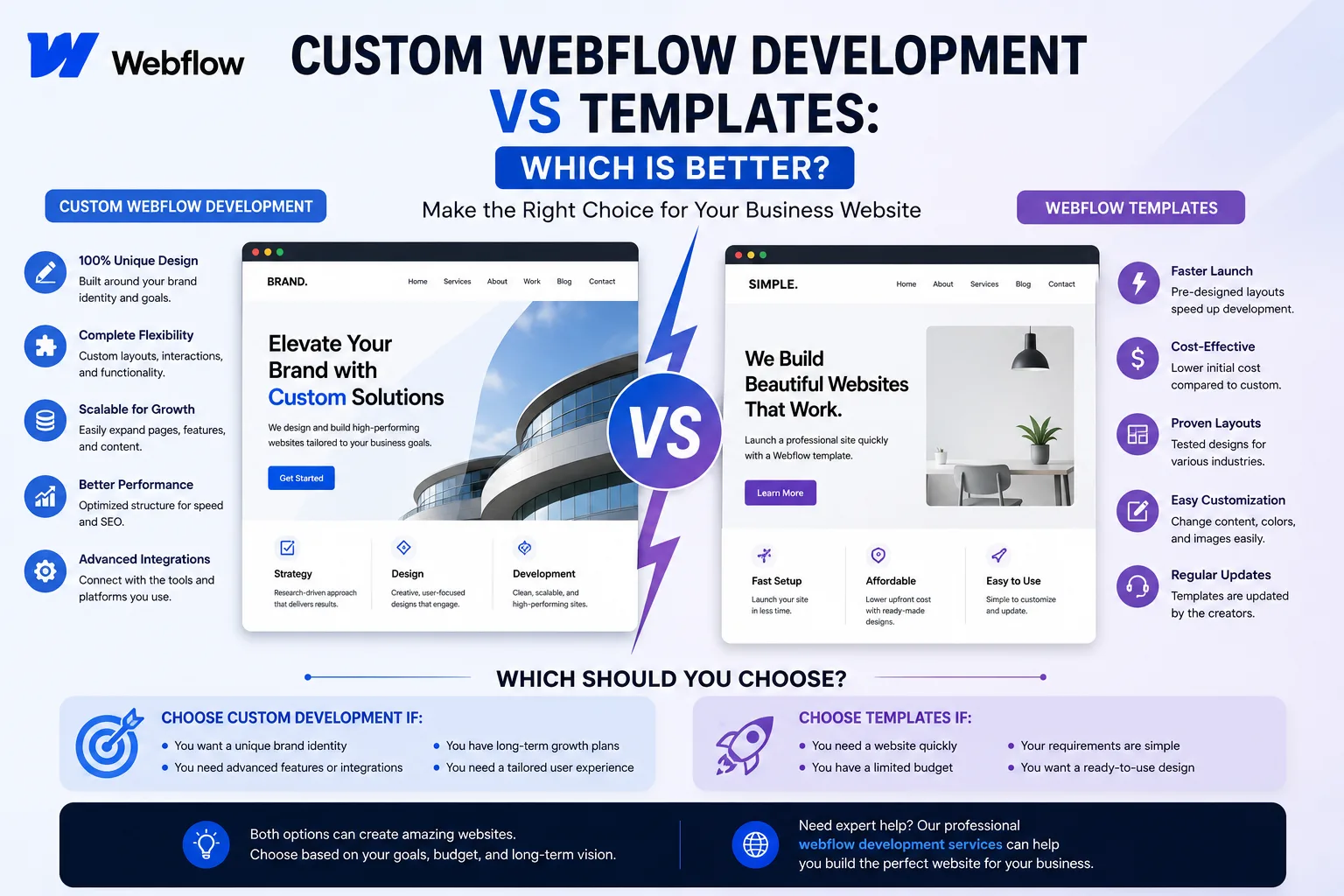
Choosing the right approach for a business website is an important decision. A website needs to look professional, represent the brand accurately, work well across devices, and provide a smooth experience for visitors. With Webflow, businesses have two common options: start with a pre-designed template or build a website using a custom development approach.
Both options have advantages. Templates can help businesses launch quickly and keep initial costs manageable, while custom development provides greater flexibility and control. The better choice depends on the business's goals, budget, timeline, design requirements, and plans for future growth.
In this guide, we will compare custom Webflow development and templates to help you determine which approach makes the most sense for your business.
What Is a Webflow Template?
A Webflow template is a pre-designed website layout created for a specific type of website or business. Templates usually include several ready-made pages, sections, navigation elements, styling, and visual components.
Instead of starting from a blank project, businesses can purchase or use a suitable template and customize it with their own content and branding.
Templates can be useful for:
- Small businesses
- Personal websites
- Portfolios
- Startups
- Simple service websites
- Landing pages
- Businesses with limited development budgets
The main advantage is convenience. Much of the basic design and structure is already available, allowing a business to get started more quickly.
What Is Custom Webflow Development?
Custom Webflow development involves creating a website specifically around a business's brand, goals, audience, content, and functionality requirements.
Rather than adapting an existing template, the development process starts with a custom design or a carefully planned structure. Developers can create unique layouts, reusable components, CMS structures, interactions, and integrations based on the project's needs.
Custom development is often suitable for:
- Established businesses
- Growing companies
- Agencies
- SaaS companies
- E-commerce brands
- Professional service businesses
- Companies with unique branding
- Businesses requiring advanced functionality
The biggest advantage is control. The website can be designed and developed around the business rather than forcing the business to adapt to an existing layout.
Custom Webflow Development vs Templates: Key Differences
The two approaches can both produce professional websites, but they differ in several important areas.
1. Design Flexibility
Templates:
Templates provide a predefined structure. You can change colors, fonts, images, text, and other elements, but the overall layout may still resemble the original design.
Custom Development:
A custom website can be designed around your exact brand identity. Layouts, sections, navigation, typography, animations, and other visual elements can be created specifically for your business.
Winner: Custom development
If having a distinctive brand presence is important, custom development offers significantly more flexibility.
2. Development Time
Templates:
Templates generally allow faster development because many design and layout elements are already built. Once the content and branding are prepared, customization can begin immediately.
Custom Development:
Custom projects usually take longer because the design, structure, components, responsive behavior, and functionality need to be planned and developed from the ground up.
Winner: Templates
If your main priority is launching a website quickly, a template may be the more practical choice.
3. Cost
Templates:
Templates can reduce initial development costs because you are starting with an existing design and structure. However, extensive customization can still require professional development work.
Custom Development:
A custom website typically requires a larger initial investment because more design, development, testing, and planning are involved.
Winner: Templates
For businesses working with a limited initial budget, a template can be an effective starting point.
However, price should not be the only consideration. A website that requires extensive modifications to make a template fit your brand may eventually cost more than expected.
4. Branding
Your website should communicate your brand consistently. This includes colors, typography, imagery, layouts, messaging, and overall visual personality.
Templates are designed for broad audiences, so another business may use the same or a very similar design.
Custom development allows every major visual element to be built around your brand.
Winner: Custom development
For businesses that want a unique digital identity, custom development is generally the stronger option.
5. Functionality
Templates usually include common website features such as navigation, contact forms, service sections, blogs, and standard page layouts.
If you require unusual functionality, advanced interactions, custom calculators, specialized forms, external integrations, or unique content structures, modifying a template can become more complicated.
Custom development allows the functionality to be planned around your actual requirements.
Winner: Custom development
6. Scalability
A business website may start with ten pages and eventually grow to fifty or one hundred pages. You may add new services, locations, blog content, case studies, resources, or other sections.
Templates can support growth, but their original structure may eventually become restrictive.
Custom development allows developers to create reusable components and CMS structures with future expansion in mind.
Winner: Custom development
7. User Experience
A template is designed to work for a broad category of users. However, your customers may have specific needs that require a different website structure.
Custom development can organize content around your audience's journey. Navigation, calls to action, forms, page layouts, and interactions can all be designed to support specific business goals.
Winner: Custom development
8. Maintenance
Templates can be easier to maintain initially because the structure is already established. However, extensive customization can make the project more difficult to manage.
A properly structured custom Webflow website can also be easy to maintain because reusable components and organized CMS collections can simplify future updates.
The key is not whether the website uses a template or custom development, but how well the project is structured.
Winner: It depends
When Should You Choose a Webflow Template?
A template may be the right option when speed and simplicity are your main priorities.
Consider using a template if:
- You need a website quickly.
- Your business has a limited initial budget.
- Your website requirements are relatively simple.
- You do not need advanced functionality.
- You find a template that closely matches your brand.
- You are comfortable making moderate design compromises.
- Your website is mainly informational.
For example, a small consulting business that needs Home, About, Services, and Contact pages may not need a completely custom website.
When Should You Choose Custom Webflow Development?
Custom development becomes more attractive when your website is an important part of your business strategy.
Consider custom development if:
- Your brand requires a unique visual identity.
- You need advanced functionality.
- Your website has complex CMS requirements.
- You expect significant future growth.
- You need multiple third-party integrations.
- You want a highly customized user experience.
- Your website needs specialized landing pages.
- You want complete control over the website structure.
- Your website is a major source of leads or sales.
For a growing company, investing in a strong website foundation can reduce the need for major redevelopment later.
Can a Template Be Customized?
Yes. One of the biggest advantages of Webflow templates is that they can be customized.
Businesses can often modify:
- Colors
- Fonts
- Images
- Text
- Buttons
- Sections
- Navigation
- Page layouts
- CMS content
- Animations
However, there is a limit to how much customization makes sense.
If you need to change almost every major part of a template, you may spend considerable time and money modifying the existing structure. At that point, starting with a custom design may be more efficient.
The Hidden Cost of Choosing a Template
A template can appear cheaper at first, but businesses should consider the total cost of customization.
For example, suppose a template requires major changes to:
- Navigation
- Homepage structure
- Service layouts
- Typography
- Mobile responsiveness
- CMS architecture
- Animations
- Forms
The development work required to make these changes can significantly increase the final cost.
Therefore, do not evaluate a template based only on its purchase price. Consider how closely it matches your actual requirements.
Why Professional Webflow Development Can Help
Businesses that need a more customized website may benefit from professional webflow development services.
Professional developers can help with:
- Custom website development
- Responsive design
- CMS architecture
- Reusable components
- Custom interactions
- Third-party integrations
- Performance optimization
- Technical SEO foundations
- Website testing
- Ongoing maintenance
The value comes from creating a website that is not only visually appealing but also structured around the business's long-term needs.
A Simple Decision-Making Framework
If you are unsure which option to choose, consider these questions:
Choose a Template If:
- Speed: You need to launch quickly.
- Budget: You want to minimize initial development costs.
- Simplicity: Your website has straightforward requirements.
- Design: You are happy with an existing layout.
- Functionality: You do not need advanced customization.
Choose Custom Development If:
- Branding: You need a distinctive visual identity.
- Growth: You expect the website to expand.
- Functionality: You need specialized features.
- Experience: You want a website designed around your audience.
- Integration: You need connections with external platforms.
- Control: You want greater control over the website structure.
Frequently Asked Questions
Is custom Webflow development better than using a template?
Neither option is universally better. Custom development provides more flexibility and control, while templates offer speed and affordability. The best choice depends on your requirements and budget.
Are Webflow templates good for business websites?
Yes. A well-designed template can be suitable for a small or straightforward business website, particularly when the template closely matches the company's needs.
Is custom Webflow development more expensive?
Generally, custom development requires a larger initial investment because more planning, design, development, and testing are involved. However, it can provide greater long-term flexibility.
Can I start with a Webflow template and customize it later?
Yes. You can customize many aspects of a Webflow template. However, extensive changes may become time-consuming, so it is worth choosing a template that is already close to your desired design and structure.
Which option is better for SEO?
Both templates and custom websites can provide a foundation for SEO. What matters is how the website is structured, optimized, and maintained. Factors such as content quality, page structure, performance, mobile usability, metadata, and technical SEO all matter.
Which option is better for a growing business?
Custom development is often better suited to businesses expecting significant growth because the website can be structured around future content, functionality, and scalability requirements.
Conclusion
The choice between custom Webflow development and a template ultimately depends on what your business needs from its website.
Templates are a practical choice for businesses that prioritize speed, affordability, and simplicity. They can provide a professional foundation without requiring a completely custom development process.
Custom Webflow development is a stronger choice when your website needs a unique brand identity, specialized functionality, advanced CMS structures, integrations, or long-term scalability. Although the initial investment may be higher, a custom website can provide greater control and flexibility as your business grows.
Before making a decision, consider your budget, timeline, design expectations, functionality, target audience, and future plans. The best website is not necessarily the most expensive or the most customized one. It is the one that effectively supports your business goals while providing a strong experience for your visitors.