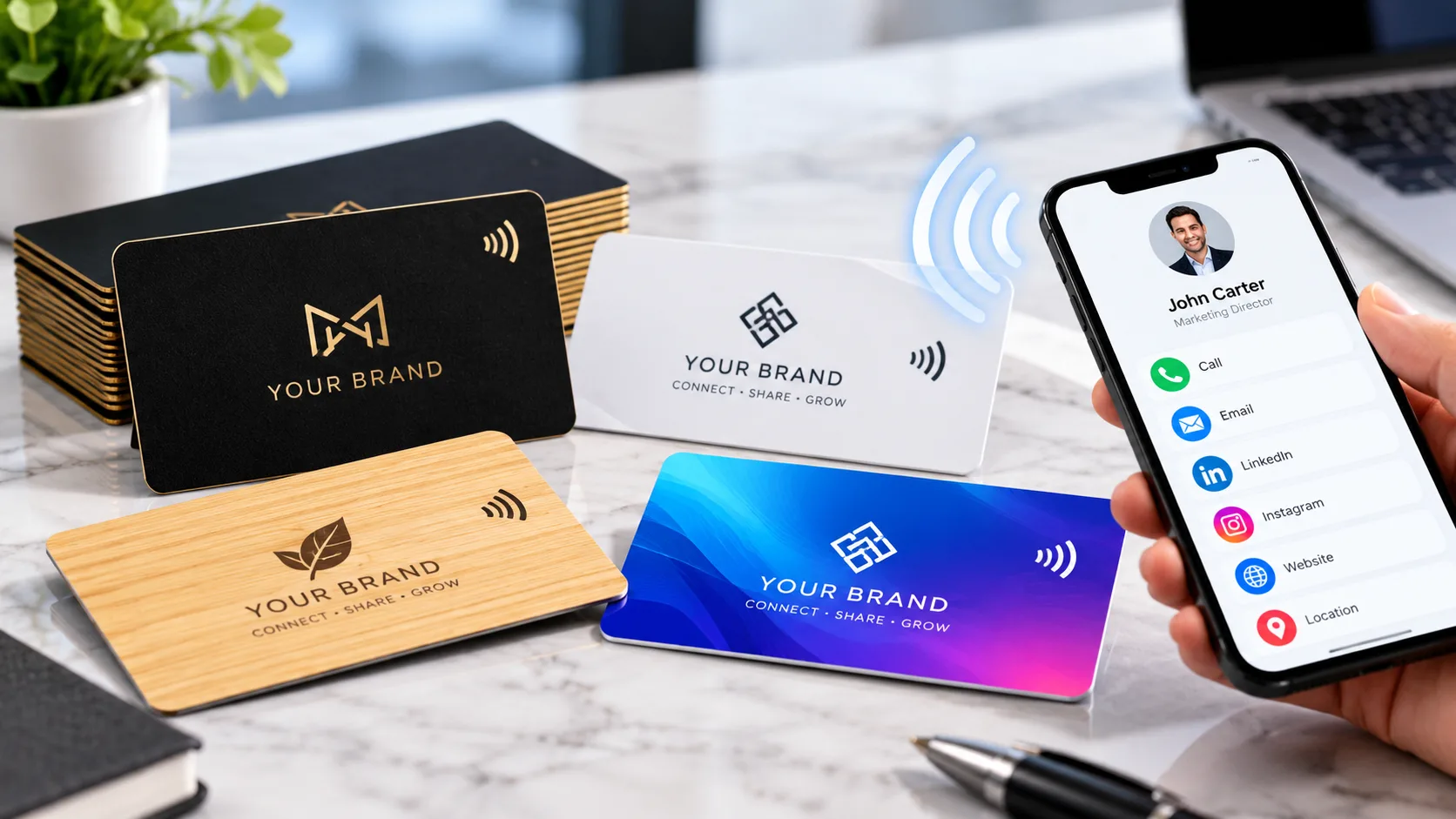
Near field communication, usually shortened to NFC, allows two devices to exchange small amounts of data at a very short range. When an NFC chip is built into a business card, a person can hold a smartphone near the card and open a web page, a contact file, or a social profile without typing anything. Custom NFC card printing combines the visual design of a traditional card with this embedded technology. This article explains how tap-to-share cards work and which design options affect their appearance and performance.
How Tap to Share Cards Work
An NFC card contains a small chip and a thin antenna, both sealed inside the card body. The chip does not need a battery. It draws a small amount of power from the phone when the phone comes within range, which is usually about an inch or two.
The chip stores data in a standard format called NDEF. The most common entry is a URL, which tells the phone to open a specific web page. Other entries can include contact details, a phone number, or a text message. Most current smartphones can read these tags, though the exact reading position on the phone varies by model.
Chip Types and Memory
Different chips offer different amounts of storage. The NTAG series is widely used for cards. The NTAG213 holds about 144 bytes, the NTAG215 about 504 bytes, and the NTAG216 about 888 bytes. A short URL needs very little space, so most business cards work well with the smallest option. Larger chips are more useful when a card stores a full contact record.
Writable and Locked Chips
An NFC chip can be left writable or locked after programming. A writable chip lets the owner change the stored link later. A locked chip cannot be edited, which prevents accidental or unauthorized changes. Many users store a link to a page they can update, so the card itself stays the same while the destination changes.
Card Materials and Construction
Most NFC cards are made from PVC, PET, or recycled plastic. The chip and antenna are laminated between layers, so the surface looks like any other plastic card. A standard card measures 3.5 by 2 inches and is often about 30 mil thick, similar to a credit card.
Opaque, Frosted, and Clear Options
Opaque cards hide the chip and antenna completely, which gives the cleanest look. Frosted cards are semi-transparent, and the internal parts may be faintly visible. Clear cards show the antenna clearly. Some designers use this feature as part of the artwork, while others prefer to hide it with a white ink layer.
Design Options for the Printed Surface
The printed design must work around the technology inside the card. Several choices affect both appearance and function.
Color and Layout
Printed colors follow the same rules as other plastic cards. Brand colors are defined with Pantone, CMYK, RGB, or HEX values, and printers usually work in CMYK or Pantone spot colors. A clean layout with a clear visual hierarchy keeps the name, title, and contact details easy to find. Many designers place the logo on one side and a short call to action on the other.
Tap Indicators
A small icon or short phrase, such as a tap symbol or the words “tap here,” tells people where and how to use the card. Placing the indicator over the antenna area helps users position their phone correctly. This small element removes confusion for people who have not used an NFC card before.
Finishes and Effects
Plastic allows gloss, matte, spot gloss, embossing, and foil stamping. Metal materials can interfere with NFC signals, so foil and metallic inks need careful placement. Large areas of metallic foil over the antenna can weaken or block the connection. A printer can advise on safe areas, and a test sample confirms that the finish does not affect reading.
Combining NFC With Other Design Elements
An NFC card does not have to rely on a single method. Adding a second way to reach the same information makes the card useful for more people.
QR Code as a Backup
A printed QR code can link to the same page as the NFC chip. It works with any phone camera, including devices that do not read NFC. The code needs a dark color on a light background and enough size to scan reliably. A short web address printed near the code offers a third option.
Preparing Artwork and Data
Two sets of information are needed for a finished card: the artwork and the data stored on the chip.
Artwork Files
Files are usually submitted as PDF with vector logos, CMYK or named Pantone colors, bleed on all sides, and fonts converted to outlines. Raster images should be 300 dots per inch at actual size. A template from the printer shows the trim line, bleed, and the antenna zone to avoid.
Chip Data and Testing
The link or contact file should be confirmed before programming. A typo in the stored URL is difficult to correct on a locked chip. After production, each card should be tested with both iPhone and Android devices. Testing a sample before a full run helps confirm that the tap area, the design, and the stored data all work together.
Choosing a Printing Provider
Not every printer handles embedded electronics in the same way. A suitable provider should explain the chip types it uses, the programming options, the materials, and the finishes that are safe for NFC. Clear specifications and proof approval are common signs of a controlled process.
Perfect Plastic Cards is one example of a company that offers custom NFC card printing with choices in material, finish, and shape, along with guidance for artwork preparation. Organizations that compare an NFC card printing service can use details like these to check whether a supplier fits the technical needs of the project.
Conclusion
Custom NFC card printing joins visual design and embedded technology in a single product. The main decisions involve chip type, card material, printed layout, finishes that will not interfere with the signal, and a clear tap indicator. When artwork and chip data are both verified with a sample, the finished card can share information reliably while keeping the look of the brand. Teams that work with an NFC card printing service benefit from confirming each of these points before approving a full run.