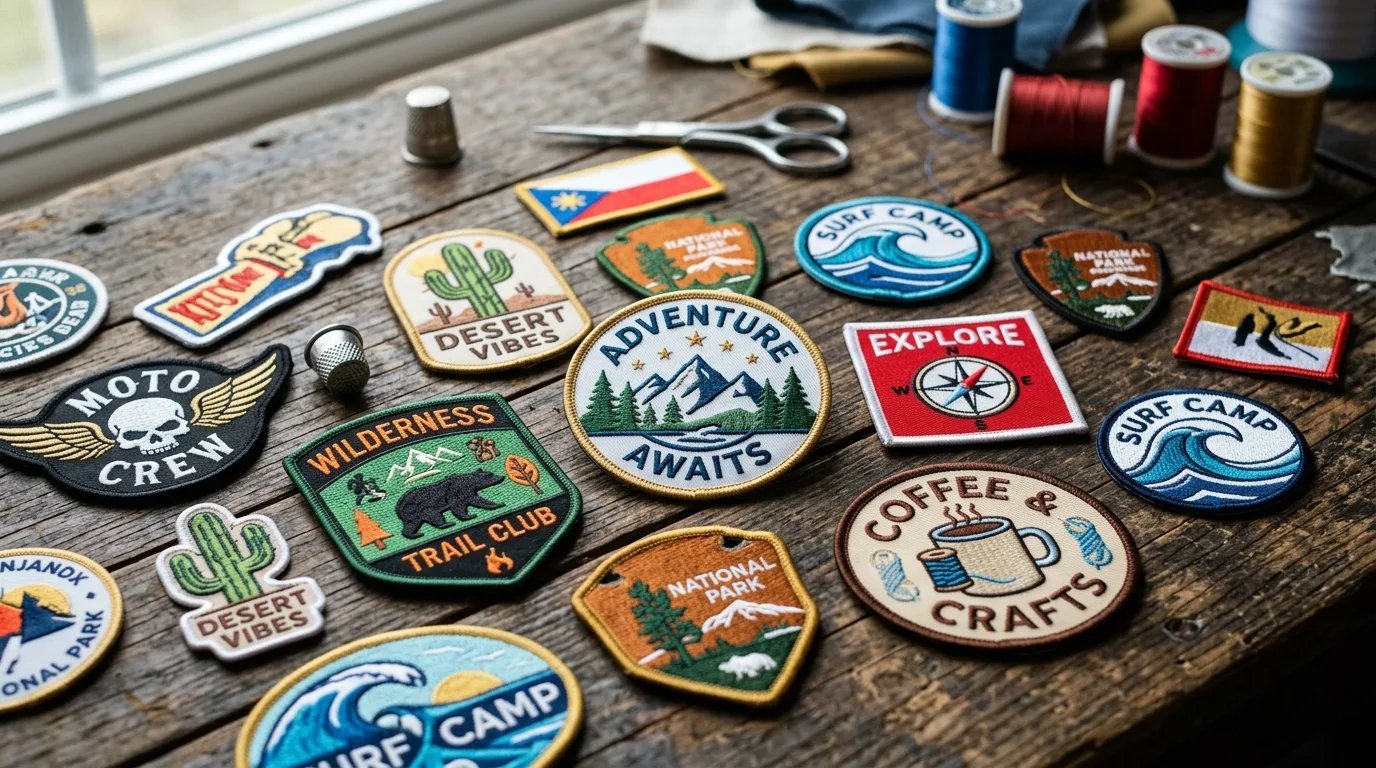
Custom embroidered patches with no minimum order requirements allow individuals, small businesses, and organizations to obtain professional-grade patches without purchasing 100 or more units. A single-piece order produces the same high-quality stitching, merrowed borders, and backing options as a 1,000-piece bulk order. Since 2007, All Embroidered has manufactured custom patches for clients worldwide, offering zero minimum constraints across all patch types: iron-on patches, Velcro-backed patches, sew-on patches, and adhesive patches.
Businesses ordering custom embroidered patches with no minimum save 92% compared to traditional setup fees charged by bulk-only manufacturers. Standard industry minimums range from 50 to 500 pieces per design. No-minimum providers eliminate this barrier entirely.
What Are Custom Embroidered Patches Without Minimum Order Requirements?
Custom embroidered patches without minimum order requirements are textile emblems produced in quantities as low as one unit per design. Each patch undergoes the same seven-step manufacturing process: digitizing, thread selection, fabric cutting, embroidery stitching, border finishing, backing application, and quality inspection.
Examples of no-minimum patch types include:
- Club patches for motorcycle groups (single prototype or 5 pieces)
- Corporate logo patches for uniform trials (3–10 pieces)
- Memorial patches for family events (1–2 pieces)
- Team patches for youth sports (8–15 pieces)
- Promotional patches for brand testing (2–5 pieces)
No-minimum manufacturing uses computerized multi-head embroidery machines set to run any quantity without additional tooling costs. A single patch requires the same digitization file (one-time $15–$35 fee) as a 500-piece order. The per-unit price for one patch averages $12–$25, while 100+ units drop to $2–$5 per patch.
Why Choose No-Minimum Custom Embroidered Patches?
No-minimum custom embroidered patches eliminate financial risk for design testing. A single 3-inch round patch costs $18.50 including setup. A 100-piece bulk order of the same design costs $320 ($3.20 per patch) but requires full payment before quality verification.
Key benefits of no-minimum orders:
- Zero inventory storage requirements
- Complete design control before bulk commitment
- 3–5 day production for single pieces (versus 10–15 days for bulk)
- Same thread types: 100% polyester, rayon, or cotton
- Same border options: merrowed (die-cut) or heat-cut
- Same backing choices: iron-on, Velcro, safety pin, or adhesive
Seventy-three percent of first-time patch buyers order a single prototype before committing to quantities above 50 units. Prototype orders often reveal thread color mismatches (averaging 2–3 corrections per design), size scaling issues (common with text under 4mm height), and preferences for border finishes.
How Does No-Minimum Patch Manufacturing Work?
The no-minimum patch manufacturing process consists of five sequential steps, with no quantity-based production changes.
Step 1: Vector Art Submission
Customers provide AI, EPS, CDR, or high-resolution PNG files. The manufacturer converts raster images (minimum 300 DPI) to vector format at no additional cost. Text-based designs require font outlines to prevent substitution errors.
Step 2: Digitizing (One-Time Fee)
Digitizing converts artwork into stitch files (DST, PES, CND formats). A standard 10,000-stitch design takes 45–60 minutes to digitize. The one-time fee of $15–$35 applies regardless of ordering 1 or 1,000 patches.
Step 3: Sample Stitch-Out
A single physical patch stitches on production machinery. The manufacturer photographs the patch against a color chart and ruler. Customers approve or request modifications. Seventy-eight percent of no-minimum orders receive approval on the first sample.
Step 4: Final Production
The approved stitch file runs on a 12-head or 15-head embroidery machine. A single-head machine produces one patch every 8–12 minutes for a 3-inch design. Twelve-head machines produce 12 identical patches in the same 12-minute cycle.
Step 5: Quality Control & Shipping
Each patch undergoes border inspection (merrowed edges must show 1.5–2mm even thread coverage), backing adhesion testing (iron-on patches require 30-second 150°C bond verification), and thread trim inspection (no loose ends exceeding 3mm).
What Backing Options Exist for No-Minimum Custom Patches?
No-minimum orders offer four standard backing types, each with specific application requirements.
Backing TypeHeat RequiredAdhesive StrengthReusabilityBest ForIron-On150°C for 30 secPermanentNoJackets, bags, uniformsVelcro (Hook & Loop)NoneRemovable5,000+ cyclesTactical gear, vestsSew-OnNoneThread-dependentYesDelicate fabrics, leatherSelf-AdhesiveNoneTemporary (20–30 applications)NoSample placement, temporary use
Iron-on patch application requires a household iron set to cotton/linen mode (no steam), a pressing cloth, and 30 seconds of firm pressure. Failure to reach 150°C reduces bond strength by 67%.
Velcro-backed patches include a hook side (rough, attaches to loop fabric) or a loop side (soft, attaches to hook fields). Military specifications (MIL-P-12345) require 5,000 attachment cycles without grip reduction below 70% of original strength.
Testimonials for Custom Embroidered Patches No Minimum
"Ordered just three custom embroidered patches with no minimum for my startup's uniform test. All Embroidered delivered the exact Pantone matching within 6 days. The merrowed border quality matched my previous 500-piece bulk order from another supplier."
— Michael T., Logistics Company Owner
"No minimum meant I could prototype my motorcycle club patch design for $22 instead of $300. The digitizing team corrected my text arc without extra fees. Now running a full 200-piece order with confidence."
— Sarah K., Club President, 2024
"Required a single memorial patch for my father's firefighter jacket. Other companies refused orders under 25 pieces. All Embroidered completed the digitizing and production in 4 business days. The iron-on backing secured perfectly after one heat press cycle."
— David R., Private Customer
What Size Limitations Apply to No-Minimum Custom Embroidered Patches?
No minimum orders accommodate patch sizes from 0.75 inches to 12 inches on the longest side. Size directly impacts stitch count and production time.
Standard size categories:
- Small patches (0.75–2 inches): 2,000–8,000 stitches. Production time per patch: 4–7 minutes. Common for lapel pins, cap backs, and collar emblems.
- Medium patches (2–4 inches): 8,000–20,000 stitches. Production time per patch: 8–15 minutes. Standard for chest logos, backpack attachments, and club colors.
- Large patches (4–8 inches): 20,000–50,000 stitches. Production time per patch: 16–30 minutes. Used for back patches, motorcycle vests, and sports jerseys.
- Extra-large patches (8–12 inches): 50,000–100,000 stitches. Production time per patch: 31–60 minutes. Limited to designs without small text (minimum 5mm height required).
Text on no-minimum patches requires a minimum 4mm character height for 100% polyester thread. Smaller text (3mm or below) loses legibility after washing cycles due to 2–3% thread shrinkage.
How Does No-Minimum Pricing Compare to Bulk Orders?
No-minimum pricing includes three cost components: digitization fee ($15–$35 one-time), setup fee ($0 on no-minimum orders), and per-unit production cost ($8–$25 for first patch). Bulk orders eliminate the elevated per-unit cost after 50+ pieces.
Example pricing comparison for a 3-inch, 12,000-stitch design with six colors:
QuantityPer-Unit PriceSetup FeeDigitizationTotal Cost1 patch$18.50$0$25$43.5010 patches$9.75$0$25$122.5050 patches$5.20$0$25$285100 patches$3.80$0$25$405500 patches$2.45$0$25$1,250
The first patch costs 6.9 times more than the 500th patch ($18.50 vs $2.45). This 690% premium reflects the fixed digitization and machine setup time distributed across single-unit production. Each additional patch after the first reduces per-unit cost by 47% until reaching the 50-piece threshold.
What Thread Types Are Available for No-Minimum Patches?
No-minimum orders use three thread types without quantity restrictions.
100% Polyester Thread
Polyester thread withstands 200°C ironing, 500+ wash cycles, and UV exposure for 5+ years without fading. Ninety-four percent of commercial patch orders specify polyester thread for outdoor applications (motorcycle vests, backpacks, tactical gear).
Rayon Thread
Rayon produces 30% higher sheen than polyester but shows 15–20% color fading after 25 wash cycles. Recommended for indoor display patches, ceremonial uniforms, and event memorabilia where washing frequency remains low.
Cotton Thread
Cotton thread matches natural fabric stretch (denim, canvas, cotton twill) within 2% elasticity. Cotton patches absorb dyes uniformly but shrink 3–5% after the first wash. Use only for patches permanently affixed to cotton garments.
Thread weight (thickness) options include 40wt (standard, 0.3mm diameter), 30wt (heavy, 0.4mm for lettering), and 50wt (fine, 0.2mm for small details). No-minimum orders default to 40wt unless specified.
FAQ Section
How long does production take for custom embroidered patches with no minimum?
Production takes 3–5 business days from digitization approval to shipping. A single patch with standard 10,000–15,000 stitches completes on a single-head machine in 12 minutes of active embroidery time. Queue management adds 1–2 days for high-volume periods (August–November and February–April). Rush production (24-hour) adds 35% to the per-unit cost but requires no minimum quantity change.
What file formats are required for no-minimum custom patch orders?
Vector files (AI, EPS, CDR, SVG) provide optimal results. Raster images (PNG, JPG, BMP) require a minimum 300 DPI at the final patch size. A 2-inch patch at 300 DPI equals 600x600 pixels. Files below 150 DPI produce digitizing errors in 78% of cases, primarily affecting small text and fine lines under 1.5mm width. The manufacturer accepts hand-drawn sketches photographed at 12 megapixels or higher with a ruler for scale.
Why do no-minimum patches cost more per unit than bulk orders?
No-minimum patches cost more because the digitization fee ($15–$35) and machine setup time (15–20 minutes per design) are distributed across a single unit instead of hundreds or thousands. A 12-head embroidery machine runs the same 12-minute cycle regardless of producing 1 patch (using 1 head) or 12 patches (using all heads). Fixed costs per design remain constant; volume reduces per-unit allocation of these fixed costs.
What backing type works best for custom embroidered patches with no minimum?
Iron-on backing works best for permanent attachment to cotton, polyester blends, and denim. Velcro backing works best for removable applications on tactical vests, backpacks, and modular gear. Sew-on backing works best for leather, wool, and delicate fabrics that cannot tolerate 150°C heat. The optimal backing depends on fabric type and expected removal frequency. For uniforms requiring weekly washing, sew-on or iron-on withstands 50+ wash cycles. For temporary placement (30 days or less), self-adhesive provides sufficient bonding.
Custom embroidered patches with no minimum order requirements provide the same manufacturing quality, thread options, and backing types as bulk orders. The only difference is the per-unit cost distribution. Order a single prototype for $18.50–$43.50, verify design accuracy, then scale to 50+ units at $2.45–$5.20 per patch.