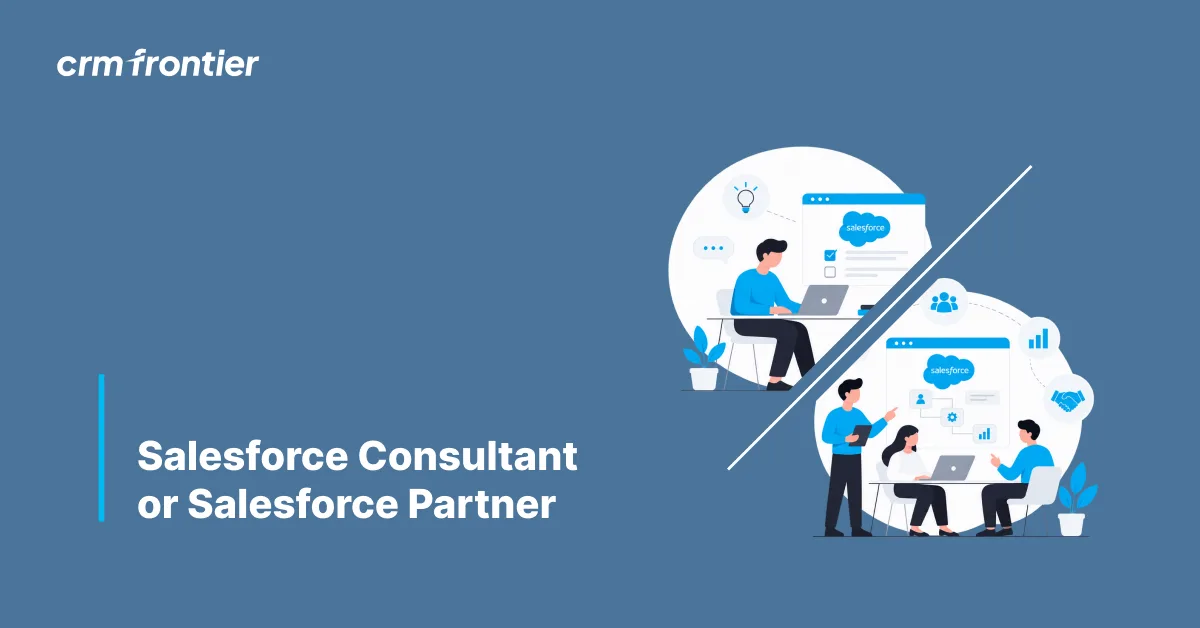
Choosing the right Salesforce expertise can make a significant difference to your CRM performance, business processes, and long-term growth. Whether you are implementing Salesforce for the first time, improving an existing CRM, or integrating multiple business applications, selecting the right professional is essential.
For UK businesses, the decision often comes down to hiring a Salesforce consultant or working with a Salesforce partner. Although both can help organisations maximise their Salesforce investment, their delivery capabilities, project responsibilities, and resources may differ.
In this guide, we explain the key differences between a consultant and a partner, their benefits, and how to decide which option is right for your business.
What Is a Salesforce Consultant?
A Salesforce consultant is a specialist who helps businesses plan, configure, optimise, and manage their Salesforce CRM environment. Their primary responsibility is to understand business requirements and recommend solutions that align Salesforce with operational goals.
Depending on the project, a consultant may work independently, as part of an internal team, or through a consultancy.
Typical responsibilities include:
- Analysing existing business processes and CRM requirements.
- Recommending Salesforce features and configurations.
- Improving sales workflows and customer management processes.
- Creating reports, dashboards, and workflow automations.
- Advising on data quality, CRM adoption, and platform optimisation.
- Providing user training and technical guidance.
Businesses often hire a Salesforce consultant when they need specialist expertise for a defined task, a CRM audit, or improvements to an existing Salesforce environment.
What Is a Salesforce Partner?
A Salesforce partner is a company that provides Salesforce-related consulting, implementation, integration, development, or support services. Depending on its capabilities and engagement model, a partner can bring together consultants, developers, architects, project managers, and support specialists.
A suitable Salesforce partner can help manage projects that require multiple skills and coordinated delivery.
Common services include:
- Salesforce implementation and configuration.
- Data migration from legacy CRM platforms.
- Integration with ERP, marketing, finance, and collaboration systems.
- Custom development and business process automation.
- User training and change management.
- Post-implementation maintenance and technical support.
A Salesforce implementation partner is particularly useful when a business needs a coordinated team to plan, deploy, and maintain a CRM solution rather than relying on a single specialist.
Before hiring, verify the provider's current Salesforce credentials, relevant experience, and the specific services included in its proposal.
Salesforce Consultant vs Salesforce Partner: Key Differences
Understanding the differences can help you make a more informed hiring decision.
Comparison factorSalesforce ConsultantSalesforce PartnerWorking modelIndividual specialist or consultant within a teamConsultancy or services companyMain focusAdvice, configuration, optimisation, or specific tasksBroader consulting and project deliveryProject scopeOften suitable for focused assignmentsOften suitable for multi-stage projectsTeam resourcesDepends on the consultant's skills and availabilityMay provide multiple specialistsImplementationCan handle implementations depending on expertiseCan coordinate end-to-end implementationIntegrationsDepends on technical capabilitiesMay offer dedicated integration resourcesOngoing supportAvailable depending on the engagementMay provide structured support packagesCost structureHourly, daily, or project-based feesFixed-price projects, milestones, or service retainersThese are general differences rather than strict rules. An experienced independent consultant may manage a complex implementation, while a smaller partner may specialise in a narrow set of Salesforce services.
The most important consideration is whether the provider has the expertise, capacity, and delivery approach your project requires.
When Should You Hire a Salesforce Consultant?
Hiring an individual consultant can be a practical choice when your requirements are clearly defined and you need targeted expertise.
Consider this option if your business needs:
1. A Salesforce CRM audit
If your current Salesforce setup has reporting issues, duplicate records, inefficient workflows, or low user adoption, a consultant can assess the environment and recommend improvements.
2. Specific configuration changes
You may need to update fields, dashboards, reports, permissions, or automation rules without undertaking a complete implementation.
3. Expert advice and planning
A consultant can help you evaluate your business requirements, identify suitable Salesforce features, and create an improvement roadmap.
4. Short-term specialist support
If your internal CRM team needs temporary assistance with a particular challenge, hiring a consultant may provide the required skills without committing to a larger engagement.
However, confirm that the consultant can deliver the technical work you need. Strategic advice alone may not be sufficient if your project also involves development, complex integrations, testing, or data migration.
When Should You Hire a Salesforce Partner?
A partner may be the better option when your project involves multiple business functions, several technical workstreams, or ongoing delivery responsibilities.
1. Implementing Salesforce from scratch
If your organisation is moving from spreadsheets, a legacy CRM, or another platform, you may need support with discovery, system design, configuration, data migration, testing, and deployment.
A Salesforce implementation partner can coordinate these activities and help establish a structured implementation process.
2. Integrating multiple business applications
Many organisations use Salesforce alongside accounting software, marketing automation platforms, ERP systems, and document management tools.
Complex integrations may require developers, solution architects, and integration specialists working together. A partner with the appropriate resources can coordinate these technical requirements.
3. Managing large or multi-team projects
Businesses deploying Salesforce across sales, customer service, and marketing may need project management, stakeholder coordination, training, and change management.
A partner can provide access to different specialists according to the project's needs.
4. Getting long-term support
Salesforce environments require ongoing attention as business processes, integrations, and user requirements evolve.
A partner offering managed services or ongoing support can help businesses resolve issues, maintain system performance, and identify opportunities for improvement.
Salesforce Consulting Services: What Should You Expect?
Effective Salesforce consulting services should address your business objectives rather than simply introduce more technology.
A good engagement typically includes the following stages:
Discovery and requirements analysis: Understand existing processes, challenges, stakeholders, and expected outcomes.
Solution design: Identify suitable Salesforce capabilities, integration requirements, data structures, and automation opportunities.
Configuration and implementation: Build and configure the agreed solution, with custom development where genuinely required.
Testing and deployment: Validate functionality, resolve issues, prepare users, and plan the transition to the live environment.
Training and optimisation: Help employees adopt the platform and identify further improvements after launch.
The scope will depend on whether you need strategic consulting, implementation, development, or ongoing support. Ask for clear deliverables, responsibilities, timelines, and exclusions before committing to a project.
How to Choose a Salesforce Consulting Partner in the UK
If you decide to work with a company rather than an individual, evaluate potential providers against several practical criteria.
Check relevant experience
Look for experience with your Salesforce products, business processes, integrations, and project size. A provider with relevant experience is better positioned to understand your requirements and identify potential challenges.
Verify certifications and credentials
Ask which team members will work on your project and whether they hold relevant Salesforce certifications. If partner status matters to your procurement process, verify the organisation's current standing through official Salesforce resources.
Evaluate technical capabilities
Confirm that the provider can support the required configuration, custom development, data migration, integrations, security, and reporting.
Understand the pricing model
Request a detailed proposal covering project scope, milestones, payment terms, support arrangements, and potential additional costs. Compare the expected value and delivery responsibilities rather than selecting a provider solely on price.
Ask about post-launch support
Clarify who will resolve issues after deployment, how support requests will be handled, and whether documentation and knowledge transfer are included.
Review communication and project management
Choose a provider that explains technical decisions clearly, provides progress updates, and involves your team throughout the project.
Salesforce Consultant or Salesforce Partner: Which Is More Cost-Effective?
The cost depends on the project scope, specialist experience, technical complexity, and support requirements.
An individual consultant may be more economical for a short assignment, CRM review, or specific configuration task. A partner may involve a larger initial commitment but provide better coordination when multiple specialists are needed.
For example, a business that only needs dashboard improvements may not require a full implementation team. However, a business migrating data, connecting several applications, and deploying Salesforce across multiple departments may benefit from a coordinated partner-led approach.
When comparing proposals, consider the total cost of delivery, including implementation, testing, training, maintenance, and potential rework. The most cost-effective option is the one that meets your requirements reliably and supports your long-term business objectives.
Why Consider CRM Frontier for Salesforce Consulting?
CRM Frontier helps businesses explore Salesforce solutions aligned with their operational requirements and growth objectives.
Whether your organisation needs guidance on an existing CRM or assistance with a wider implementation, the right engagement should begin with a clear understanding of your goals, current systems, and technical requirements.
CRM Frontier's Salesforce-related services can be considered when evaluating options for implementation, integration, optimisation, and ongoing support. Before choosing any provider, discuss your project scope, delivery approach, relevant expertise, and post-launch requirements to establish whether the engagement is a suitable fit.
If you are comparing your options, read our detailed guide on Salesforce Consultant or Salesforce Partner to understand which approach may suit your organisation.
Frequently Asked Questions
1. What is the difference between a Salesforce consultant and a Salesforce partner?
A Salesforce consultant is an individual specialist who provides advice or hands-on technical assistance. A Salesforce partner is a company that may offer consulting, implementation, salesforce integration, development, and ongoing support through a team of professionals. The right option depends on the project's scope and complexity.
2. Does CRM Frontier provide Salesforce consulting services in the UK?
Yes, CRM Frontier offers Salesforce consulting services for UK businesses, helping them align their CRM systems with business processes, improve workflows, and enhance user adoption.
3. Is CRM Frontier a Salesforce implementation partner?
CRM Frontier provides Salesforce implementation services, helping businesses plan, configure, deploy, and improve their Salesforce environments. Businesses can discuss their project requirements with the team to determine the right implementation approach.
4. What Salesforce services does CRM Frontier offer?
CRM Frontier offers services including Salesforce implementation, integration, customisation, optimisation, and ongoing support to help businesses manage their CRM systems effectively.
5. Can CRM Frontier help integrate Salesforce with other business applications?
Yes, CRM Frontier provides Salesforce integration services to help connect Salesforce with other business applications, streamline data exchange, reduce manual work, and improve operational efficiency.
6. Does CRM Frontier provide ongoing Salesforce support?
Yes, CRM Frontier offers Salesforce support services that can include troubleshooting, system administration, workflow improvements, reporting assistance, and integration support.
7. How can I choose between a Salesforce consultant and a Salesforce partner?
A Salesforce consultant may be suitable for specific technical tasks or expert advice, while a Salesforce partner may be better suited to projects requiring multiple specialists, implementation management, integrations, and ongoing support. The right choice depends on your business goals, budget, and project complexity.
8. How can I contact CRM Frontier for Salesforce consulting?
You can visit the CRM Frontier UK website to explore its Salesforce services and contact the team to discuss your business requirements.
Conclusion
Choosing between a Salesforce consultant and a Salesforce partner depends on your business objectives, project complexity, budget, and internal capabilities.
A consultant can be the right choice for targeted advice and specialist tasks, while a partner may offer broader resources for implementations, integrations, and ongoing CRM management.
Before making a decision, define your requirements, compare delivery capabilities, verify credentials, and understand the full cost of the engagement. By choosing a provider that fits your needs, your business can make better use of Salesforce and build a CRM environment that supports long-term growth.