CPA Affiliate Marketing Explained: How Brands Turn Conversions Into Growth
Every brand has been there - you pour money into ads, watch the clicks roll in, and then... nothing. No real sales, no leads, just a shrinking budget and a lot of "well, at least people saw it."
That's the exact problem CPA affiliate marketing was built to fix. Instead of paying for attention, you pay for results. And once you experience that shift, it's hard to justify going back to the old way of doing things.
What Is CPA Marketing?
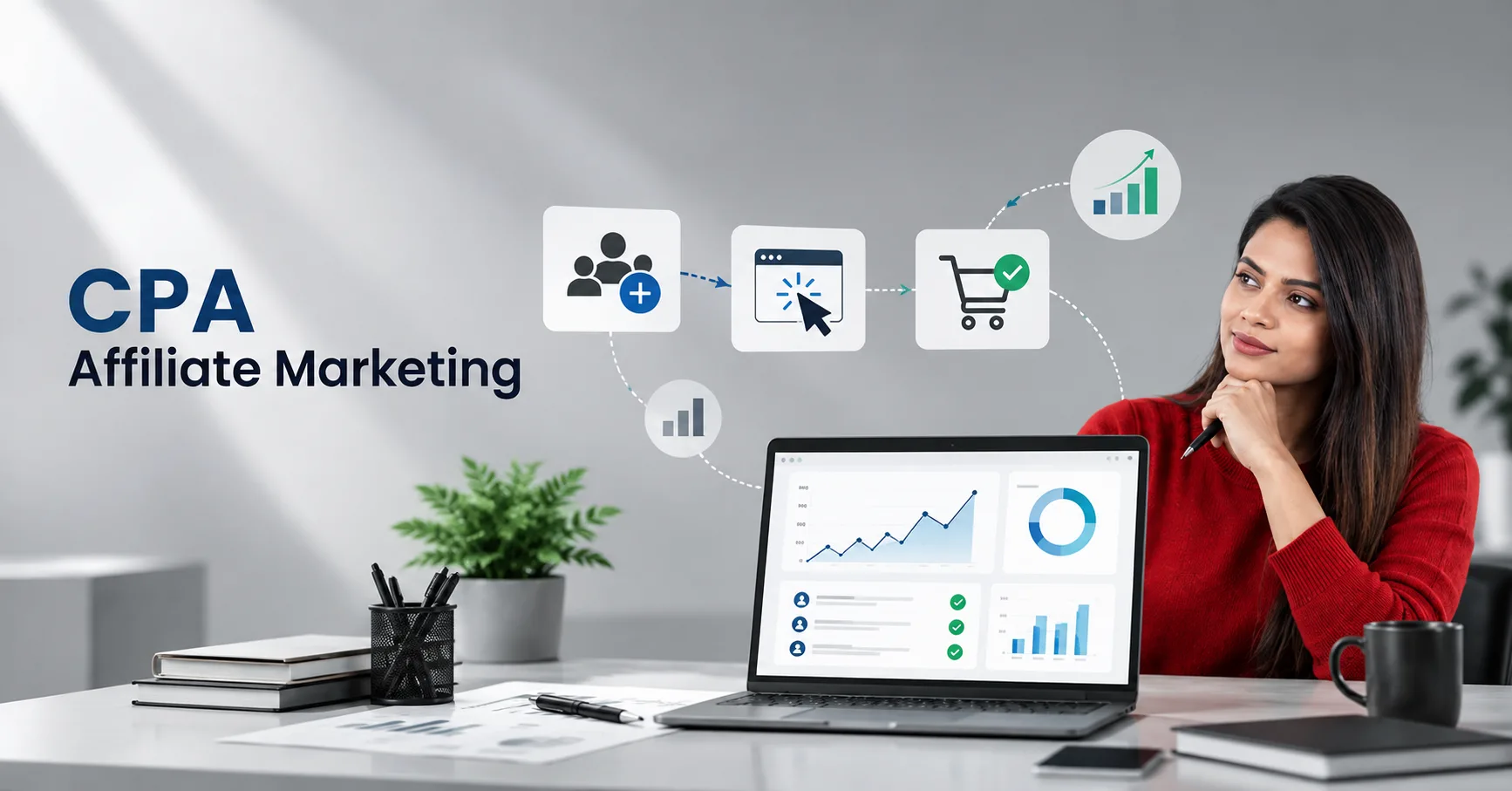
The term CPA stands for Cost Per Action, and it refers to a performance-based marketing strategy where an affiliate gets paid only in case the visitor takes a certain desired action - purchases something, subscribes, fills out the form, downloads the application, etc.
The absence of any actions equals no payments, and that is how the whole thing works.
How does CPA compare to other common models of affiliate marketing?
- CPC (Cost Per Click): You pay each time somebody clicks on something - conversion or not. Risky unless you have a well-tuned conversion funnel.
- CPM (Cost Per Mille): You pay for each 1,000 views of your ads. A good choice for creating brand awareness but not very accountable.
- Revenue Share: The affiliate is paid according to their sales. This one works perfectly for recurring revenue businesses but makes it difficult to estimate acquisition costs.
So, CPA affiliate marketing falls somewhere in between the two as the cleanest way to go about things.
Why CPA Marketing Works for Modern Businesses?
This model isn't just theory - it works because it solves real, practical problems brands run into every day.
- You only pay for what actually happens. No guessing games, no hoping a click eventually turns into a sale.
- Lower financial risk. A weak creative or poor targeting doesn't drain your budget the way it would with CPC or CPM.
- Affiliates are motivated to perform. Since their income depends on delivering real conversions, good affiliates get smart about traffic quality instead of chasing volume.
- Forecasting becomes simple. Once you know your cost per acquisition, you can measure it directly against customer lifetime value and know if a campaign is actually profitable.
The catch? None of this works without solid tracking. If you can't measure what's converting, you're optimizing blind - no matter how good the offer looks on paper.
Key CPA Marketing Models Explained
All "actions" are not equal and that is what CPA is all about.
- Cost per lead (CPL): Payment is received whenever anyone shares their contact details, either in terms of subscribing to an email list or asking for a consultation. Usually applied to finance, education and B2B sectors.
- Cost per sale (CPS): Payout will be made only when there is a purchase of some kind. This is the default choice of almost all ecommerce firms.
- Cost per install (CPI): This is very popular among mobile application makers and payment is received only when there is a download and installation.
- CPA marketing in its broad sense: This includes special actions such as viewing videos, filling out quizzes and scheduling a demo session.
Many agencies operate both CPL and CPA at the same time and that is why you will hear terms like CPL CPA affiliate marketing. It is quite logical because while CPL helps in getting genuinely interested leads, CPA takes care of closing the deals.
Here's a quick side-by-side for clarity:
ModelWhat You Pay ForBest ForRisk LevelCPA (Cost Per Action)A completed action - sale, signup, installRevenue tied directly to spendLow - you only pay for real outcomesCPL (Cost Per Lead)Contact info - email, phone, form fillBuilding a future sales pipelineLow to moderateCPC (Cost Per Click)Every click, regardless of outcomeTraffic and awareness campaignsHigher - clicks don't guarantee conversionsPerformance-Based Affiliate Strategies That Drive Results
Getting CPA right isn't about signing up for a network and posting offers. It comes down to a few fundamentals:
- Pick high-intent offers. Products or services with proven demand and a solid landing page convert far better than generic offers.
- Target the right audience first. Generic traffic is cheap and useless. Know who you're targeting - their pain points, buying intent, behavior - and match the offer accordingly.
- Tighten your funnel. Every step between the click and the conversion is a potential leak. Page speed, form friction, and message clarity all matter more than people think.
- Track everything properly. Pixels, postback URLs, server-to-server integrations - invest in this early. Multi-touch attribution shows you what's actually driving results instead of just crediting the last click.
Pairing this with native advertising services adds another layer of trust. Native ads blend into the platform instead of interrupting it, which means people engage with them the way they'd engage with normal content - and that trust carries through to the conversion.
Performance video advertising works the same way. A short video showing a product in action often converts far better than a static banner because it tells a story fast, before the scroll continues.
Tools and Platforms Used in CPA Marketing
Execution quality depends heavily on your tech stack. A few categories worth knowing:
CategoryExamplesWhat It DoesTracking & AnalyticsServer-side tracking platformsTracks clicks and conversions at a granular level - increasingly important as browser tracking gets restrictedAffiliate NetworksVetted partner networksConnects advertisers with affiliates while handling payouts and complianceLanding Page ToolsA/B testing platformsHelps optimize page speed, mobile experience, and message match to boost conversionsGood tools don't guarantee success on their own, but bad tools guarantee inefficiency. It's worth investing in infrastructure that actually matches your goals.
Common Mistakes in CPA Marketing
Even experienced marketers slip up here. The usual culprits:
- Chasing high payouts over relevance. A big commission means nothing if the offer doesn't fit the audience.
- Ignoring traffic quality. Cheap, low-intent traffic looks fine on a report and converts poorly in real life.
- Weak tracking setup. Broken attribution means you're optimizing based on guesswork instead of actual data.
Avoiding just these three puts a campaign ahead of most.
Scaling CPA Marketing Campaigns Successfully
If something works, the task that comes after is growing it without ruining it.
- Use data all the time. Segment performance by traffic sources, creative, devices and times of day. Double down on those that work; fire the rest quickly.
- Use automation where you can. Manual optimization will take you so far; rules-based bidding and automation allow you to focus on strategy.
- Focus your efforts on your best affiliates. Usually, there is a small number of affiliates responsible for the bulk of your results. Good compensation and access to offers will motivate them.
Effective scaling has little to do with money and everything with making sure your processes work efficiently.
Also read: CPL vs CPA Marketing: Which Performance Model Is Right for Your Business?
The Future of CPA Marketing
A few shifts are already shaping where this model is headed:
- Smarter, AI-assisted optimization for real-time bid adjustments and creative personalization.
- Better attribution models that credit the full customer journey instead of just the last click.
- Privacy-first tracking, as cookies fade out and first-party, server-side data becomes the new standard.
The core idea - paying for performance - isn't going anywhere. How that performance gets tracked and optimized is what's evolving fast.
Role of Prudigital Media in High-Performance CPA Marketing
Strong CPA results depend on accurate tracking, fast funnels, and distribution that actually reaches the right people. This is where Prudigital Media fits in.
We combine performance marketing services with native advertising services, performance video advertising, and smart Performance Distribution to make sure every campaign isn't just live - it's actually converting. From setting up clean tracking infrastructure to matching the right affiliates with the right offers, we handle the pieces that make CPA campaigns scalable instead of a one-time win.
Want a CPA strategy built around real performance, not guesswork? Get in touch with our team and let's map out a campaign that actually delivers.
Conclusion
CPA affiliate marketing comes down to one simple shift - paying for outcomes instead of attention. Brands get predictable, results-driven growth, and affiliates get rewarded for real effort instead of guesswork.
When you layer in native advertising, performance video advertising, and thoughtful Performance Distribution, you get a system built for consistent, scalable growth - which is exactly the kind of performance-first approach Prudigital Media brings to every campaign we run.
Frequently Asked Questions
1. Is CPA affiliate marketing limited to large firms?
Absolutely not; smaller companies can enjoy this model more since they just get billed on the basis of actual performance.
2. How does CPA differ from CPC?
While CPC bills the customer based on click-throughs irrespective of anything else, CPA pays only on completion of a desired action by the user, thus being a more performance-oriented mode.
3. Do I have to use either video or native ad placement for CPA?
No, though combining these would definitely result in higher levels of engagement and conversions.
4. How quickly can I expect some kind of result from a CPA marketing campaign?
Generally, within 2-3 weeks most of the brands start noticing tangible results from their campaigns.