
There's a particular kind of professional frustration that doesn't get talked about enough. It's the experience of knowing—with complete certainty—that you have more to offer than what's coming across. Your thinking is sharp. Your instincts are sound. Your ideas are genuinely good. But somewhere between what you know and what your audience receives, something gets lost.
That gap is more common than most leaders admit. And it's more consequential than most organizations acknowledge.
Communication isn't just one dimension of leadership effectiveness—it's the dimension through which every other capability becomes visible. Strategic thinking that can't be articulated doesn't drive decisions. Empathy that isn't expressed doesn't build trust. Vision that isn't communicated compellingly doesn't inspire action. When communication breaks down, leadership effectiveness breaks down with it—regardless of how strong everything underneath might be.
Why Generic Development Doesn't Solve a Personal Problem
Most professionals have sat through at least one communication skills training program. A workshop here, a course there, perhaps a company-wide initiative built around a popular framework. Some of it lands. Most of it fades within weeks—not because the content was wrong, but because it was designed for everyone and therefore optimized for no one.
Here's the reality: communication challenges are deeply personal. They're rooted in individual habits, histories, and patterns that have developed over years. The executive who dominates conversations without realizing it has a different challenge than the one who holds back insights until they've been perfectly formulated. The leader who speaks with authority in one-on-one settings but loses presence in large groups has a different development need than the one who excels on stage but struggles in unstructured dialogue.
Generic training can introduce useful concepts. But it can't see your specific patterns, challenge your particular blind spots, or design a development path calibrated to exactly where you are and where you need to go. That's what communication coaching does—and why its outcomes look so different from what group training programs typically produce.
What Personalized Coaching Actually Uncovers
One of the most consistent things we observe at Moxie Institute is that the communication challenge a leader thinks they have and the one they actually have are often not the same thing. A leader who believes their problem is nerves frequently discovers that nerves are a symptom of an underlying structural issue—their message isn't clear enough to deliver with confidence because it hasn't been built with enough intention. A leader who thinks they need to work on their delivery discovers that their delivery is actually quite strong, but their tendency to over-explain is diluting the impact of every point they make.
This is precisely why the diagnostic phase of real communication coaching matters so much. Before any skill-building begins, a skilled coach observes, listens, and asks the questions that surface what's actually happening beneath the surface-level symptoms. What does this leader do when they're under pressure? How does their communication change when they're uncertain? What stories do they tell themselves about why they communicate the way they do—and how accurate are those stories?
The answers to those questions shape everything that follows. They determine which skills to develop first, which habits to interrupt, and which strengths to build upon rather than overwrite.
The Skills That Personalized Development Builds
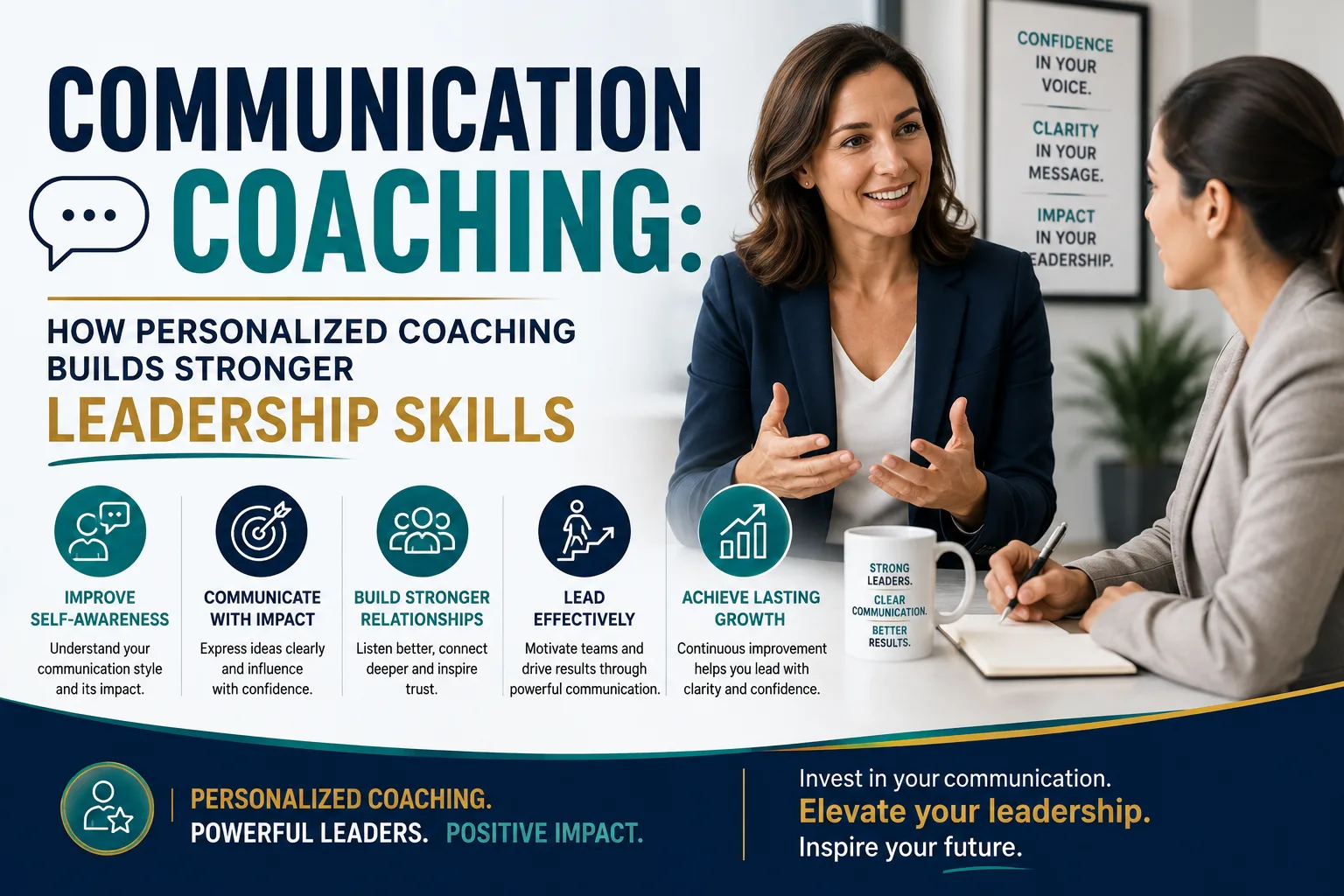
Effective communication training at the individual level addresses a broader range of capabilities than most professionals initially expect. Yes, it includes the visible dimensions—clarity of message, vocal presence, physical confidence, storytelling ability. But the most transformative work often happens at a deeper level.
Self-awareness is foundational. Leaders who understand how they're perceived—not how they intend to come across, but how they actually land—have the information they need to make meaningful adjustments. Without that awareness, even highly motivated leaders keep repeating patterns they can't see. Coaching creates the mirror.
Emotional regulation under pressure is another capability that personalized development addresses directly. The ability to stay grounded, clear, and connected to your message when a conversation gets difficult or a room gets tense isn't a personality trait. It's a trainable skill. And it's one of the most valuable things a leader can develop, because high-stakes communication moments are precisely when composure matters most.
Listening as a leadership skill is frequently underinvested in—partly because it feels passive, and partly because it's harder to measure than speaking ability. But working with our clients over the years, we've observed consistently that the leaders who communicate most powerfully are almost always the most intentional listeners. They ask better questions. They respond to what's actually being said rather than what they anticipated hearing. And they create the kind of conversational environment where other people do their best thinking.
The Leadership Multiplier Effect
Here's what makes investment in communication development particularly compelling from a leadership perspective: the return doesn't stay contained to communication. It multiplies across everything a leader touches.
When a leader communicates with greater clarity, their team makes better decisions. When they listen more effectively, their culture becomes more psychologically safe. When they can navigate difficult conversations with composure, conflict gets resolved rather than avoided. When their vision is compelling rather than merely logical, organizational change actually happens.
This is the multiplier effect that communication coaching creates. It doesn't just make leaders better communicators. It makes them more effective in every dimension of leadership that depends on human connection—which, when you examine it closely, is nearly all of them.
At Moxie Institute, we build personalized communication training experiences around the specific leader in front of us—their strengths, their patterns, their goals, and the real-world contexts in which they need to perform. If you're ready to close the gap between the leader you are and the one your communication allows you to be, we'd welcome the conversation. Reach out to Moxie Institute today.