Most heating decisions on a factory floor are made once and lived with for a decade. A line is commissioned, a heater type is chosen, and years later nobody remembers why. If the process drifts, energy bills creep up, or rejection rates refuse to fall, the original heating choice is rarely the first thing questioned. Yet it is often the root cause. Speaking with an experienced ceramic infrared heater manufacturer early in the planning stage can prevent many of these problems.
This article compares three common industrial heating approaches, convection, quartz infrared and ceramic infrared, so you can judge which one suits your material and your line speed.
How Each Method Delivers Heat
Convection heating warms the air inside an oven or tunnel, and that air transfers heat to the product. It is simple and familiar, and it works well for bulk, enclosed processes. The weakness is indirect transfer: you pay to heat a large volume of air, the walls and the structure before the product benefits.
Quartz infrared heating uses a tungsten or carbon filament inside a quartz tube, producing short-wave radiation. It reaches high intensity very quickly and suits fast, deep, high-temperature work. The trade-offs are fragility, glare and the risk of scorching surfaces that cannot tolerate sharp intensity.
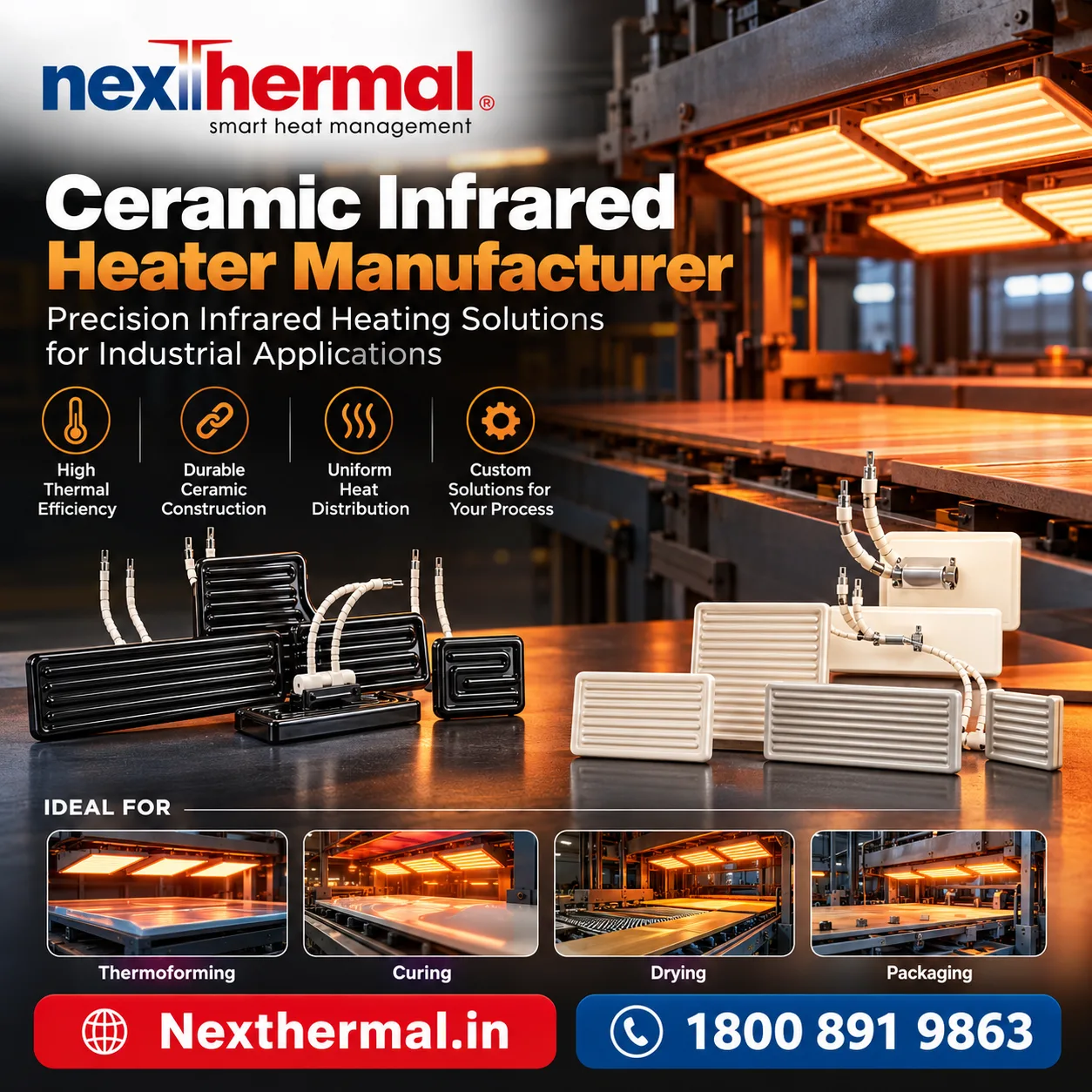
Ceramic infrared heating uses a resistance wire embedded in a ceramic body that radiates in the long-wave band. The energy is absorbed at the surface of many common materials, which makes the heating gentle and even rather than aggressive.
Matching the Method to the Material
Heat only works efficiently when the material can absorb it. That single idea explains most good and bad heating outcomes.
Water, most thermoplastics, paints, coatings, paper, textiles and many foods absorb long-wave infrared well. For these, ceramic emitters transfer energy efficiently without needing very high surface intensity. Highly reflective metals and thin, polished surfaces behave differently, and convection or short-wave radiation may suit them better.
Ask three questions before choosing any method:
- Does the material absorb heat at the surface or deep inside?
- How quickly must it reach target temperature?
- How sensitive is the product to overheating or surface marking?
If the answers are “surface, moderate speed, quite sensitive,” ceramic infrared deserves serious consideration.
Energy Use: Where the Real Difference Appears
Energy comparisons are often exaggerated in brochures, so it helps to think in terms of mechanism rather than headline percentages.
Convection systems lose energy to exhaust air, oven walls and warm-up time. Radiant systems can be switched on, directed at the product and zoned so that only the necessary area is heated. Because emitters respond within minutes, lines that start and stop often can benefit noticeably.
A poorly specified radiant system wastes energy too. Emitters installed too far from the product, or run at full power when partial output would do, throw away the advantage. The saving comes from correct design and proper control, not from the technology alone.
Heat Uniformity and Product Quality
Uniformity is where ceramic emitters tend to earn their reputation. Their broad, soft radiating surface produces a smoother heat pattern than a narrow filament source. In thermoforming, this reduces thin spots and wrinkling. In coating cure, it lowers the risk of blistering caused by surface heating too quickly.
Uniformity still depends on layout. Spacing between emitters, distance to the product, reflector design and zone control all matter. A knowledgeable ceramic elements heater manufacturer treats the emitter bank as a designed system rather than a collection of parts, and that mindset is what produces even heat in practice.
Practical Examples From the Shop Floor
Thermoforming line: A plant heating polystyrene sheets saw uneven wall thickness because the old heater bank had cold corners. Rebalancing watt density at the edges and adding zone control produced a flatter heat profile and fewer rejected parts.
Paint curing booth: A small coating unit relied on hot air and suffered long cure times and dust pickup from air movement. Switching to radiant heat shortened the cycle and reduced airborne contamination, since far less air was being moved.
Textile drying: A drying section that overheated the fabric edges improved after emitters were repositioned and the controller was tuned to prevent overshoot.
These are typical patterns, not guarantees. Every process differs, which is why testing with your own product matters more than any generic claim.
Maintenance and Service Life
Convection ovens carry fans, ducting, filters and burners or large resistance banks, all of which need periodic attention. Quartz lamps can crack with vibration, splashes or careless handling. Ceramic emitters are solid and robust, with no glass to break, and they generally tolerate vibration and handling better.
Service life still depends on operating temperature, duty cycle, power quality and contamination. Voltage fluctuation, a familiar problem in many Indian plants, shortens the life of any resistance heater. A stabilized supply and a properly rated controller are inexpensive protection.
The Role of Controls
An emitter alone does not give you a process. Temperature control turns radiant output into a repeatable result. Thermocouple or infrared sensor feedback, a good controller and a solid-state relay together hold the set point and avoid the overshoot that wastes energy and damages product.
Many troubleshooting visits end the same way: the heaters were fine, but the control strategy was a basic on/off switch. Upgrading the control loop frequently improves consistency more than replacing the heaters would.
When Ceramic Infrared Is Not the Answer
An honest comparison must include the limits. Ceramic infrared may not be the best option when:
- The product is highly reflective and absorbs little long-wave energy
- Very deep, rapid penetration is needed
- The process requires a fully enclosed, controlled air atmosphere
- Extremely high surface temperatures are required
In those cases, convection, short-wave infrared or a hybrid arrangement may work better. Many strong installations combine methods, for example radiant heat for fast surface pickup followed by gentle convection to equalize temperature.
Choosing a Supplier Who Understands the Process
The technology matters, but the supplier matters just as much. A dependable ceramic infrared heater manufacturer asks about your material, line speed, working distance and target temperature before proposing anything. They discuss voltage conditions and duty cycle, and they are willing to say when another method suits you better.
Customization is another practical indicator. Real machines have awkward dimensions and fixed mounting points, so a ceramic elements heater manufacturer that can adjust wattage, shape and terminal arrangement removes a great deal of compromise from the installation. Our own approach to application-led heating is outlined on the About Us page.
A Simple Trial Approach
Before committing to a full line, a small trial removes most of the uncertainty:
- Supply a sample of your actual product and describe the target result.
- Test a small emitter bank at two or three working distances.
- Record heating time, surface temperature and finished quality.
- Adjust spacing and power, then repeat.
- Scale up only after the results are consistent.
Share these trial records with your ceramic infrared heater manufacturer so the final specification rests on measured evidence, not estimates.
Future Outlook
Indian manufacturing is moving toward measured, documented and energy-aware processes. Heating, long treated as a background utility, is becoming a controlled variable like speed or pressure. Radiant technologies fit that shift because they can be zoned, logged and tuned with precision.
Operational Impact
Match the heating method to how your material absorbs energy, design the emitter layout deliberately, protect it with sound controls and a stable supply, and trial before scaling. Working with a capable ceramic elements heater manufacturer on these points turns heating from a source of surprises into one of the most predictable parts of your line.
Call toll-free: 1800 891 9863
Visit Our Website: https://www.nexthermal.in/
Request a quote: https://www.nexthermal.in/contact/
Product Page: https://www.nexthermal.in/ceramic/
Connect With Us
Facebook: https://www.facebook.com/nexthermal.usa/
Instagram: https://www.instagram.com/nexthermal/
YouTube: https://www.youtube.com/@nexthermal
Pinterest: https://in.pinterest.com/nexthermal/