You find a handful of winged insects on the windowsill. Or a small pile of what looks like sawdust under a baseboard. Your first thought is probably: is this carpenter ants or termites?
It's a fair question. Both insects swarm, both live in wood, and both show up in Michigan homes. But they behave very differently, they cause different damage, and they need different treatment. Guess wrong and you can spend money on the wrong fix while the real problem keeps growing inside your walls.
The good news: you can usually tell them apart in under a minute once you know what to look for. This guide walks you through the body, the wings, the damage and the timing, so you know exactly what you're dealing with before you call anyone.
Carpenter Ants vs Termites at a Glance
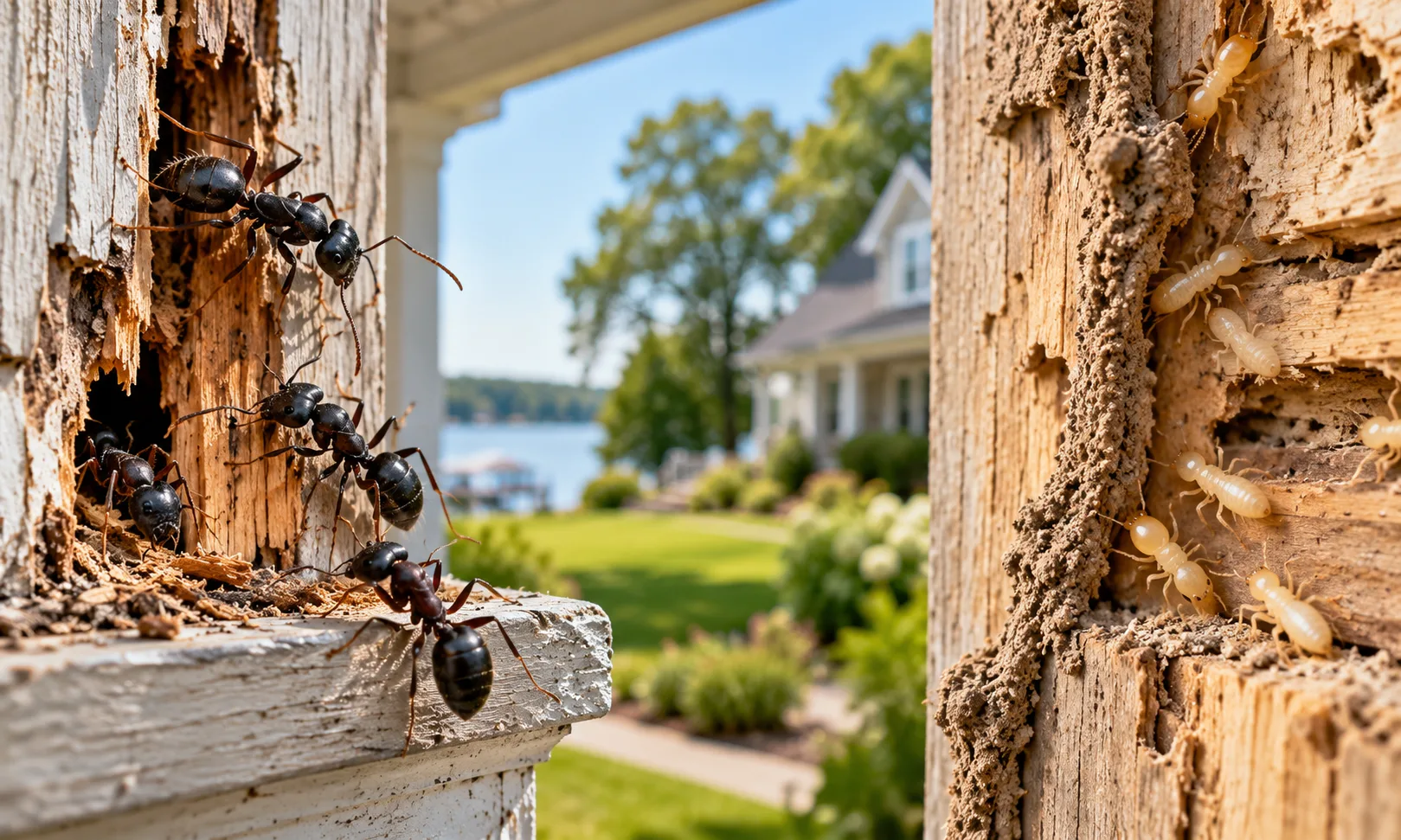
FeatureCarpenter AntsTermites (Eastern Subterranean)WaistNarrow, pinchedThick, straight; no visible waistAntennaeBent at an elbowStraight, like a string of beadsWingsFront pair longer than back pairBoth pairs about the same lengthColor (workers)Black or black and redPale, creamy whiteSizeAbout 1/4 to 1/2 inchAbout 1/8 inch (workers)What they do to woodTunnel through it to nest; don't eat itEat itDamage looks likeSmooth, clean galleriesRagged tunnels packed with mudTelltale signPiles of coarse sawdust (frass)Pencil-width mud tubes on foundation wallsWhere they nestDamp or rotting woodMoist soil, traveling up into woodWhen you see themOften at night; indoors in winter means a nest insideRarely seen except when swarmingHow to Tell Them Apart by Looking at the Insect
If you can catch one, drop it in a clear zip bag or tape it to a white card. Then check these three things.
1. The waist
This is the fastest test. A carpenter ant has a narrow, pinched waist between its thorax and abdomen, like an hourglass. A termite's body is thick and straight from front to back, with no obvious waist at all.
2. The antennae
Carpenter ant antennae bend in the middle at a sharp "elbow." Termite antennae are straight and look like a short string of tiny beads.
3. The wings (on swarmers)
Both insects grow wings during swarming season, which is why people mix them up. Look closely:
- Carpenter ants: the front wings are clearly longer than the back wings.
- Termites: all four wings are the same length and often stretch well past the end of the body.
Termites also drop their wings soon after swarming. A pile of identical, shed wings on a windowsill or near a light is a strong termite clue.
University extension entomologists note that termite swarmers are often mistaken for winged ants, and that the pinched waist, elbowed antennae and unequal wings are what give ants away.
How to Tell Them Apart by the Damage
Most homeowners never see the insect itself. What they find is the damage. Here's how each one leaves its mark.
Carpenter ant signs
- Sawdust piles (frass). Carpenter ants don't eat wood. They chew it out to make room for their nest and push the shavings outside. Look for small piles of coarse sawdust, often mixed with insect parts, below baseboards, window frames or ceiling beams.
- Smooth, clean tunnels. Break open damaged wood and the galleries look sanded, almost polished.
- Faint rustling in walls at night. Carpenter ants are most active after dark.
- Damp spots. They favor wood softened by moisture: around windows, doors, showers, tubs, dishwashers, leaky pipes and under roof shingles.
Termite signs
- Mud tubes. Subterranean termites can't survive in open air, so they build pencil-width tunnels of soil up foundation walls, piers and basement joists. This is the single clearest termite sign.
- Mud-packed wood. Damaged wood is filled with soil and has a layered, ragged look instead of clean tunnels.
- Hollow-sounding or soft wood. Tap a sill plate or floor joist with a screwdriver handle. Termite-damaged wood sounds hollow and the tip may push in easily.
- No sawdust. Termites eat the wood, so there's nothing to push out. No frass plus wood damage points toward termites.
Quick rule: sawdust usually means carpenter ants, mud usually means termites.
When Each One Shows Up in Michigan
Timing is one of the best clues, and the season you see them in tells you a lot.
Termites usually swarm in spring, often on a warm, sunny day after a rain. In Metro Detroit that's typically April into May. Swarms tend to start in the morning and last only a short time. After that, termites stay hidden in soil and wood for the rest of the year.
Carpenter ants swarm later, from late spring into summer. You'll also see foraging workers on warm evenings from spring through early fall.
The winter test. Michigan State University Extension points to one sign above all others: seeing carpenter ants indoors during winter, when it's too cold for them to be active outside. That's a very strong indication a colony is nesting inside the building, not just wandering in.
On the other hand, a few winged carpenter ants indoors in summer don't, on their own, prove there's a nest in your home. They may have come in from outside.
Which Is Worse: Carpenter Ants or Termites?
Both can damage your home, but termites are generally the bigger threat. Michigan State University Extension calls subterranean termites the most serious wood-destroying pest in Michigan, and says they're far more common than most people realize.
The reason is how they work. Termites eat wood around the clock, out of sight, and a mature colony can hold tens of thousands of insects or more. By the time a homeowner sees swarmers indoors, the colony has often been active for years.
Carpenter ants damage wood more slowly because they only hollow it out for nesting. They're still a problem worth treating. A long-running colony can weaken window frames, sills and roof framing, and their presence almost always points to a moisture issue that's causing its own damage.
Why getting the ID right matters
The two pests need completely different treatment:
- Carpenter ants are controlled by finding the nest, usually in damp wood, and treating it directly. Fixing the moisture source keeps them from coming back. Over-the-counter sprays rarely reach the nest.
- Termites need a soil-based treatment or a professional bait system around the structure. The products and equipment for this are only available to licensed pest control companies.
Treat termites like ants, or ants like termites, and you pay for a fix that doesn't touch the actual problem.
What to Do If You Find Either One
- Save a sample. Put a few insects or shed wings in a sealed bag. Photos help too, especially of the waist and antennae.
- Don't spray. Store-bought sprays kill the insects you see and scatter the rest, which makes the nest harder to find.
- Note where and when. Write down where you saw them, what time of day, and whether it's near a window, bathroom, kitchen or basement wall.
- Look for moisture. Check for leaks, soft wood or water stains near the sighting. Both pests are drawn to damp wood.
- Leave mud tubes in place. Don't scrape them off before an inspection. They show a technician exactly where termites are traveling.
- Get a professional inspection. A trained technician can confirm the species and find the source, and a licensed ant-control provider can treat the nest directly if carpenter ants are the problem.
Frequently Asked Questions
Are flying ants the same as termites?
No. Flying ants and termite swarmers look alike from a distance, but ants have a pinched waist, elbowed antennae and front wings longer than the back wings. Termites have a thick waist, straight antennae and four equal-length wings.
Do carpenter ants eat wood?
No. Carpenter ants chew through wood to build nests, then push the shavings out as sawdust. Termites are the ones that actually eat wood.
Can you have carpenter ants and termites at the same time?
Yes. Both are drawn to damp, damaged wood, so a moisture problem can attract both. That's one more reason a professional inspection is worth it.
Are there termites in Michigan?
Yes. Eastern subterranean termites live in Michigan and are more common than most homeowners expect. They nest in moist soil and travel into homes through mud tubes.
Why am I seeing big black ants in my house in winter?
It usually means a carpenter ant colony is nesting inside your home. It's too cold for them to be active outdoors, so ants indoors in winter are likely coming from a nest in your walls, floors or roof.
Is sawdust always a sign of carpenter ants?
Not always. Other wood-boring insects and old construction debris can leave sawdust too. Coarse sawdust mixed with insect parts near damp wood is the classic carpenter ant sign.