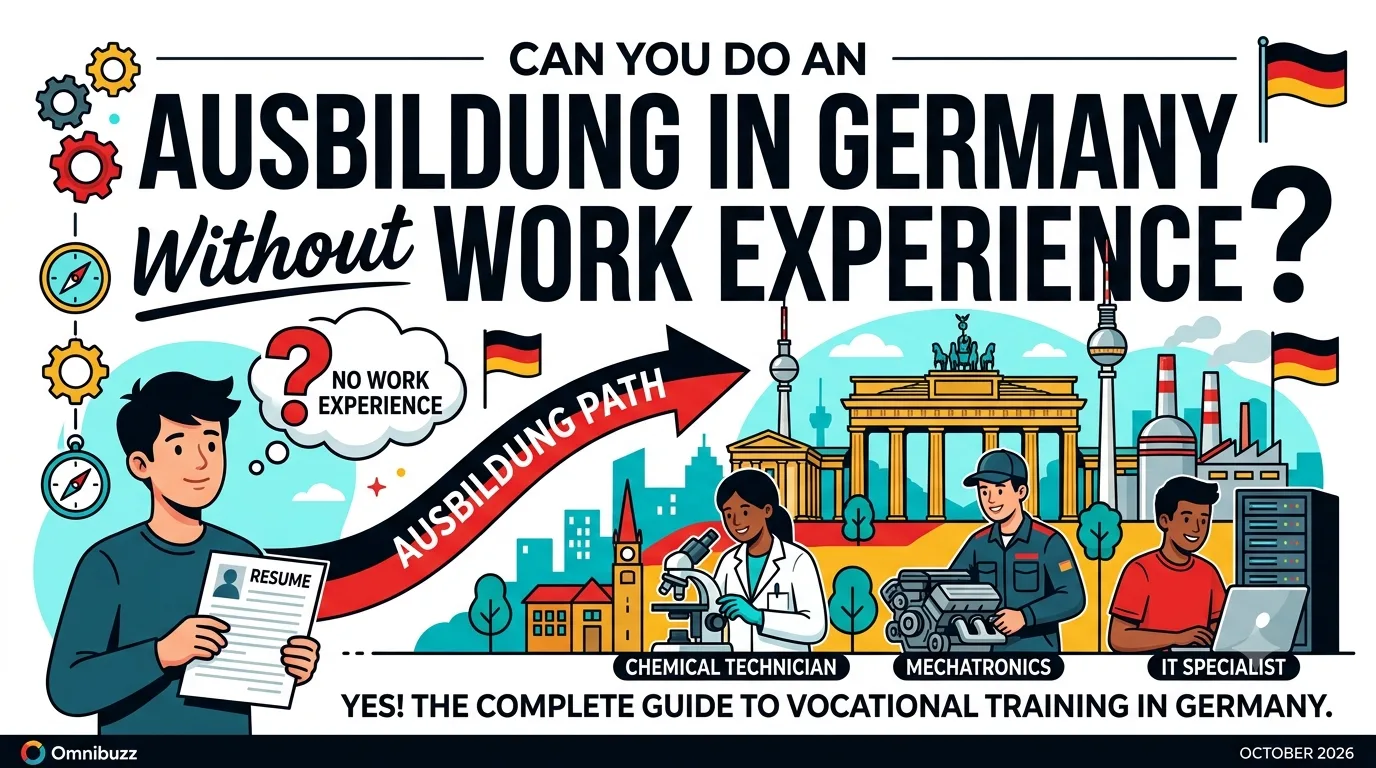
What Is an Ausbildung and How Does It Work?
An Ausbildung is the official dual vocational training system in Germany. It combines classroom instruction at a vocational school (Berufsschule) with practical paid training at a host company (Ausbildungsbetrieb) [2]. Trainees split their week between learning theoretical concepts and applying those skills on the job.
Because the system is structured as an educational program, German employers do not expect applicants to be experienced professionals. The entire purpose of dual training is to transform beginners into skilled workers over a period of two to three and a half years.
Employers care far more about your educational foundation, your language ability and your dedication to learning the trade than your past job titles.
Is Work Experience Required for an Ausbildung?
The short answer is no. German vocational laws do not require applicants to have prior job experience.
German companies hire trainees to instruct them according to national industry standards. If an applicant already possessed complete professional expertise, they would apply directly for a full position rather than a training slot.
However, while work experience is not required, applicants must satisfy basic eligibility criteria:
- School Leaving Certificate: You must have completed at least 10 to 12 years of formal schooling with passing grades [3].
- German Language Proficiency: Most vocational schools and employers require a certified B1 or B2 level in German [4].
- Motivation and Aptitude: You must demonstrate a clear interest in your chosen field through your application documents.
"The dual training system is explicitly designed for beginners. We look for motivation, language proficiency and reliability rather than a long list of previous job titles." - Vocational Admissions Guidance Report [5]
High-Demand Fields That Accept Applicants Without Experience
Certain sectors in Germany face severe labor shortages. Employers in these industries actively recruit international candidates who have no previous work background.
The table below outlines key fields, required language levels and average stipends for entry level trainees.
Vocational FieldMinimum German LevelAverage Monthly Gross StipendIndustry Demand LevelNursing and HealthcareB2€1,100 to €1,300Very HighHospitality and Culinary ArtsB1 or B2€900 to €1,100HighIT Systems IntegrationB2€1,000 to €1,200Moderate to HighLogistics and Warehouse OperationsB1€950 to €1,100HighMechatronics and Electrical EngineeringB2€1,050 to €1,250HighHealthcare and nursing offer the highest number of vacancies for international applicants. Logistics and hospitality also welcome beginners due to continuous demand across regional hubs [6].
How to Build a Winning Application Without Work Experience
When you lack professional history, your application must emphasize other core strengths. You can convince German recruiters of your potential by focusing on specific preparation steps.
1. Achieve Strong German Language Skills
Language competence is the single most important factor in your application. Obtaining a B2 Goethe, TELC or TestDaF certificate proves that you can follow technical lectures and communicate with colleagues on day one [7].
2. Write a Targeted Motivation Letter (Anschreiben)
Your cover letter is your primary tool to explain why you want to join the company. Focus on your interest in the trade, your personal goals and your willingness to adapt to German workplace culture. Mention school projects, hobbies or self-taught skills that align with the role.
3. Format Your Resume (Lebenslauf) to German Standards
Create a clean tabular resume following the standard Europass or classic German layout. Highlight your academic marks, language certificates, computer skills and extracurricular activities clearly.
4. Include Short Internships or Volunteer Work
Even short unpaid internships, school workshops or community volunteering demonstrate a strong work ethic. List these experiences to show initiative and practical interest.
"A well written motivation letter in clear German carries far more weight for dual training admissions than unverified work experience from abroad." - German Mobility Study [8]
Visa Requirements for Ausbildung Candidates Without Experience
Securing a training contract (Ausbildungsvertrag) allows international candidates to apply for a vocational training visa under Section 16a of the German Residence Act [9].
To receive visa approval from the German embassy, you must provide:
- A signed training contract with a recognized German firm
- Approval from the Federal Employment Agency (Agentur für Arbeit)
- Certified proof of German language proficiency (B1 or B2)
- Proof of adequate financial resources or a minimum stipend meeting federal thresholds
- Proof of health insurance coverage for Germany
If your monthly training stipend covers your basic living costs, you do not need to deposit funds into a blocked account.
Mistakes to Avoid When Applying
- Sending generic motivation letters to multiple companies without customizing the content
- Applying without recognized language certificates
- Relying exclusively on English language job portals when most dual programs require German
- Exaggerating skills or qualifications on your resume
"Candidates who invest early in solid language preparation consistently secure contracts faster than those relying solely on academic scores." - European Educational Mobility Review [10]
To start your German language journey, join the best German language institute in Noida today.