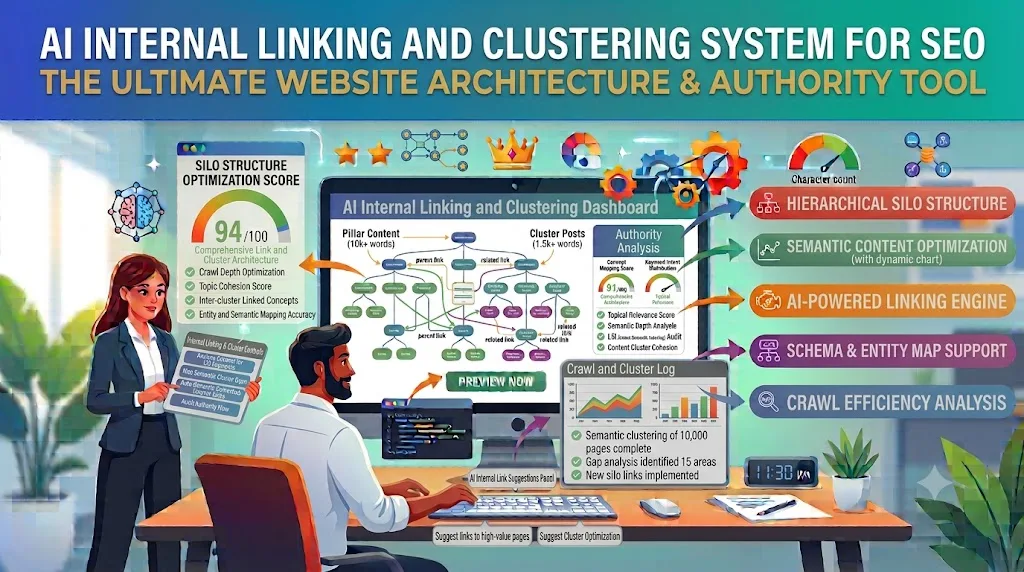
Best AI tool for SEO silo architecture
The Complete Guide to Building Website Topic Silos: Why an AI SEO Silo Builder Is the Future of Organic Rankings
Every website owner faces a critical hurdle after publishing their first fifty or one hundred blog posts. You invest countless hours researching keywords, writing thorough tutorials, and fine-tuning on-page meta tags, yet organic rankings plateau on page two or three. The culprit is rarely poor writing or lack of effort. In the overwhelming majority of cases, the real issue is an undisciplined, chaotic website architecture where related articles compete against one another instead of working as a unified entity.
Search engines like Google rank web pages through relationship mapping and topical depth. If your domain resembles an unstructured bucket where random articles sit in isolation without systematic pathways, crawling bots fail to recognize your true authority. Solving this structural issue requires building strict topic silos—a time-consuming process that traditionally involved tedious spreadsheets, link-mapping diagrams, and manual copy-pasting across dozens of pages. With the advent of a dedicated AI SEO silo builder, webmasters can now plan, generate, and synchronize complete topic hierarchies directly inside WordPress on total autopilot.
What Exactly Is an SEO Silo (and Why Do Standard AI Writers Fail at It)?
An SEO silo is a structural technique that groups related website content into dedicated, isolated themes. Rather than letting articles link randomly across unrelated topics, a silo ensures that all subtopic pages (supporting articles) link upward to a central pillar page, link laterally to sibling articles within the exact same theme, and never leak relevance to completely unrelated categories.
Consider a practical example. If you run a comprehensive automotive care platform, your content naturally divides into distinct categories:
- Silo A: Ceramic Coating & Surface Protection
- Silo B: Paint Correction & Machine Polishing
- Silo C: Interior Leather Care & Odor Removal
In a properly engineered silo, an article explaining ceramic coating curing times links directly to your core pillar guide on long-term surface protection. It might also link to an article on ceramic maintenance shampoos. However, it should never randomly link across to a post on leather stain extraction. When your linking paths are clean, Google's crawlers can navigate the semantic boundaries effortlessly.
The Disconnect with Generic AI Writers
Most digital creators turn to general-purpose language models like standard ChatGPT or Gemini prompts hoping to accelerate their publishing output. While these tools write competent sentences, they are completely blind to your live website:
- No Memory of Your Existing Content: A generic prompt generator does not know what pages already exist on your server. It cannot reference your older cornerstone post because it has no access to your sitemap.
- Zero Link Directionality: Basic AI tools cannot construct deliberate parent-child hierarchy links without painful manual intervention on every single draft.
- Keyword Cannibalization: When you generate posts in isolation, standard AI repeatedly targets identical keyword variations, causing your own articles to battle each other in search engine results pages (SERPs).
This is why using the best AI tool for SEO silo architecture changes everything. Instead of writing in a vacuum, modern automated engines interface directly with your content management system to map relationships before a single paragraph is drafted.
The Architecture of Modern Internal Linking: Transforming Mere Writing into SEO Power
Internal linking is the single most controllable ranking factor in modern search optimization. External backlinks certainly signal trust, but your internal architecture dictates how that incoming authority flows throughout your entire domain ecosystem. Without strong internal paths, your deepest transactional pages starve for link equity.
Notice how clean link distribution functions in a synchronized content environment:
[Core Category Pillar] / \ ▼ ▼ [Subtopic Spoke 1] ◄──► [Subtopic Spoke 2] \ / ▼ ▼ [Deep Supporting Guide / Case Study]
When you pair natural content writing with an automatic internal linking AI writer, this complex web of anchors is handled dynamically. The platform analyzes your live article database, identifies semantic relevancy, and inserts contextual links using natural, non-repetitive anchor phrases.
Introducing SyncRanker: The Native WordPress AI Silo Engine
SyncRanker was engineered specifically to bridge the gap between AI text generation and programmatic SEO architecture. Instead of operating as a detached web dashboard where you generate plain text files, copy them into WordPress, and manually insert hyperlinks, SyncRanker connects directly to your live environment.
Instant Onboarding via the WordPress Connector Plugin
Getting started takes less than two minutes without technical friction:
- Free Registration: Create a free account on the platform and receive 50 complimentary credits immediately to test the live generation capabilities.
- Download the Connector: Click the download button at the top of your user portal to grab the official SyncRanker Connector WordPress Plugin.
- Install and Activate: Inside your WordPress admin dashboard, navigate to Plugins > Add New > Upload Plugin, select the zip file, and click activate.
- One-Click Synchronization: Locate the SyncRanker menu item on the bottom-left sidebar of your WordPress admin area. Click the Connect / Reconnect button.
Upon clicking connect, the engine automatically onboards your website. It syncs your active categories, existing post titles, URLs, and site structure directly into its neural memory, turning it into an active AI writer with internal link synchronization.
Configuring Advanced Integrations: Local Maps & Search Console
Every business operates under unique commercial constraints. SyncRanker treats advanced features as modular options, giving you absolute freedom to build the exact workflow your project requires.
1. Local Search & Google My Business Map Embedding
For service businesses—such as mobile auto detailers, roofers, dentists, and local contractors—establishing geographic relevance is vital. SyncRanker includes a built-in gold standard feature that automatically embeds your verified Google Map into generated articles. You simply decide whether your content targets a local municipality or a global audience. When set to local, every published post reinforces your Google Map coordinates and service area signals directly to local crawlers.
2. Google Search Console (GSC) Integration
If you have an established domain with existing traffic data, connecting your Google Search Console profile unlocks algorithmic content optimization. The engine evaluates real queries, impression counts, and click-through benchmarks to identify decaying pages and underperforming clusters, allowing your next campaign to target genuine ranking opportunities.
Pro Tip: If you are launching a brand-new website with zero history, simply skip GSC integration during onboarding. You can launch your initial topic sprints immediately using the Standalone Writer Module and link GSC later once organic impressions begin populating.
Campaign Automation vs. The Standalone Writer Module
SyncRanker provides two distinct pathways to publish content depending on your editorial strategy and available credits.
FeatureContent Campaign ModuleStandalone Writer ModuleTarget Use CaseAutomated monthly planning, bulk scheduling, cluster launchesInstant on-demand articles, single-topic deep dives, surgical editsCredit StructureRequires 100 credits for automated monthly calendar creationPay-per-article; accessible via initial 50 free signup creditsTopical IntelligenceAutomatic broad category clustering and keyword hierarchyBuilt-in "Check" uniqueness engine & topical authority validatorCMS RoutingDirect scheduled publishing to WordPress draft/live queueInstant push to live WordPress or exportable markdown/HTMLBuilding a 30-Day Automated Campaign
Inside the Campaign module, the system reviews your onboarding category selections, instructions, and target objectives. When you click Create a Monthly Plan, the engine generates an entire monthly content schedule. You can inspect each planned headline individually, approve or decline specific angles, or click Add All to schedule the entire thematic silo in a single stroke.
Before any scheduled article is written, the platform provides an Edit button. This intervention gate allows you to insert custom editorial directions, specify high-priority outbound links, or embed relevant multimedia assets before the engine drafts the piece.
Watch the Full Onboarding & Campaign Setup Walkthrough
This complete demonstration walks you through WordPress plugin activation, website syncing, campaign configuration, and live publication.
Mastering the Standalone Writer Module with Built-In Topical Intelligence
For independent publishers or brand-new websites seeking immediate results, the Standalone Writer Module offers unmatched control. Because your site details and post indexes are already synced during the initial connection, the AI brain already possesses full contextual awareness.
The "Check" Uniqueness Feature
Before generating a piece, you enter your proposed headline and click the integrated Check button. The engine compares your proposed topic against all published posts on your website. If an existing post already targets that exact semantic space, it alerts you immediately—saving credits and stopping cannibalization in its tracks.
Granular Prompt & Link Injections
Once your topic passes inspection, you have granular control over every aspect of generation:
- Keywords & Semantic Tags: Specify exact secondary entities you want naturally woven into the subheadings.
- Custom Instructions: Instruct the AI on tone, specific products to mention, or technical nuances unique to your industry.
- Custom URLs & Video Embeds: Paste specific affiliate links, client pages, or video URLs (like the YouTube onboarding guide above) to be natively embedded within the generated text.
Every supplementary field remains completely optional. If you prefer total speed, enter your target topic and let the engine draft a comprehensive, interlinked post instantly.
Achieving True Topical Authority with Structured Content Networks
To dominate competitive niches in modern organic search, publishing individual standalone reviews is no longer enough. Algorithms evaluate whether your domain covers a subject exhaustively. By employing an automatic topical authority generator alongside your silo builder, you create an unbreakable network of related answers that satisfy both search bots and human visitors.
When each piece within your cluster links back to your overarching hub using clean anchors, search bots recognize your site as the definitive destination for that subject. Paired with automated internal link building for blogs, you completely eliminate the manual friction that previously made comprehensive silo architecture prohibitive for small teams.
Summary Checklist: Launching Your First AI-Powered Silo Today
- Sign up for free at SyncRanker and claim your instant 50 credits.
- Download the SyncRanker Connector Plugin from your user dashboard header.
- Upload the zip file into WordPress under Plugins > Add New and activate it.
- Click SyncRanker on your WordPress menu and press Connect.
- Complete your website profile, niche specifications, and optional Local Map settings.
- Open the Writer Module, run the Check feature to verify topic freshness, and generate your first interlinked cornerstone article.
Building high-performing topical silos no longer requires complicated spreadsheets or manual internal link audits. By combining live WordPress database synchronization with intelligent natural language architecture, you can publish rank-ready content clusters that drive sustained organic growth.