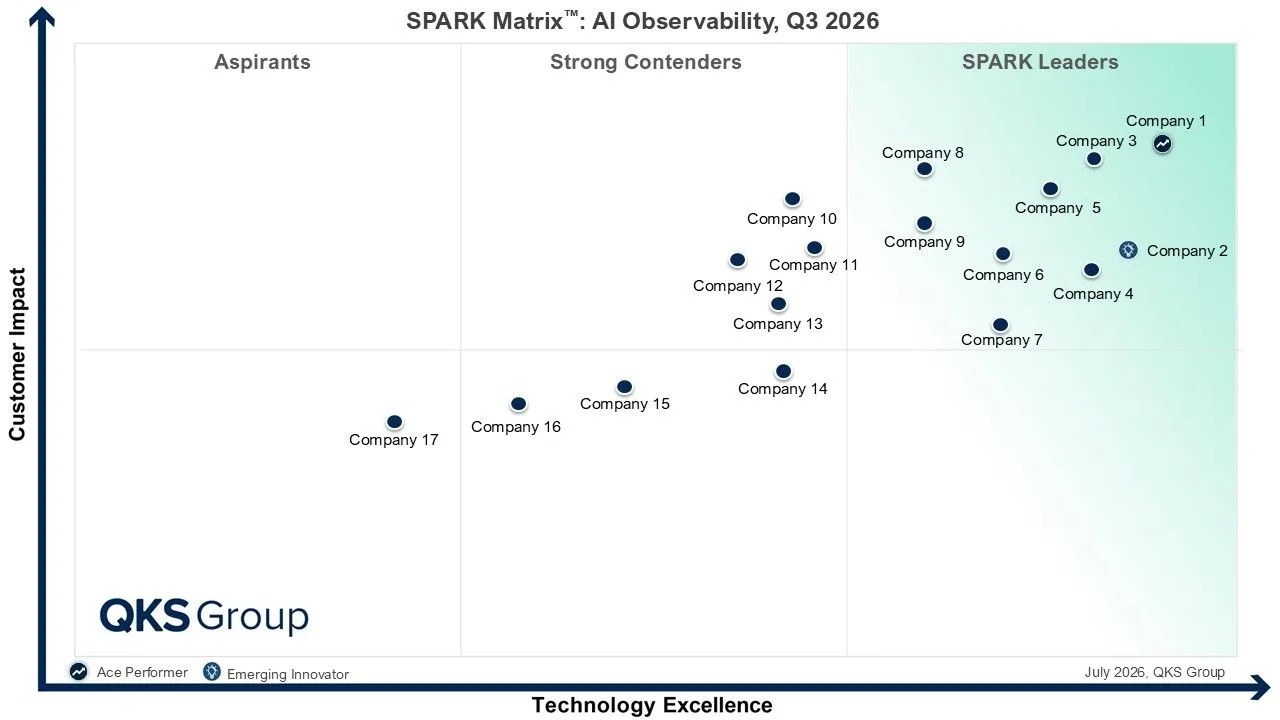
AI Observability is emerging as a critical operational discipline that provides organizations with visibility into AI system behavior, performance, quality, cost, and risks throughout the AI lifecycle. Unlike conventional application monitoring, AI observability enables enterprises to understand model behavior, evaluate outputs, trace AI workflows, identify anomalies, and establish governance controls for production AI applications.
Click here for more information : https://qksgroup.com/market-research/spark-matrix-ai-observability-q3-2026-10477
AI Observability Market: Key Trends
The AI Observability market is evolving rapidly as enterprises seek to scale AI adoption while maintaining operational resilience and trust. Several trends are shaping the market.
Growing Adoption of Generative AI and Agentic Workflows
The deployment of generative AI applications and agentic systems introduces new operational complexities. Organizations need visibility into prompts, responses, model interactions, tool calls, retrieval processes, and workflow execution. AI observability platforms help enterprises monitor these components and identify issues that may affect application reliability and user experience.
Continuous AI Monitoring and Evaluation
AI systems can produce different outcomes depending on data, prompts, models, and contextual inputs. Continuous monitoring and evaluation enable organizations to assess model quality, accuracy, latency, reliability, and other performance indicators throughout the production lifecycle.
AI Governance and Risk Management
AI observability is increasingly connected with governance requirements. Enterprises need mechanisms to monitor AI systems for reliability, safety, compliance, and business alignment. Observability platforms can support governance by providing evidence of system behavior, evaluation results, and performance trends.
QKS Group SPARK Matrix™: AI Observability
QKS Group’s AI Observability market research provides a comprehensive analysis of the global market, covering emerging technology trends, market dynamics, competitive developments, and future market outlook.
The research includes detailed competitive analysis and vendor evaluation using the proprietary SPARK Matrix™ methodology. The SPARK Matrix™ ranks and positions leading AI Observability vendors based on their capabilities and competitive differentiation, providing technology buyers with strategic insights for evaluating the evolving market landscape.
The SPARK Matrix includes analysis of vendors such as Arize AI, Cisco, Coralogix, Databricks, Datadog, Dataiku, Dynatrace, Elastic, Evidently AI, Fiddler AI, Grafana, Honeycomb, IBM, LangChain, New Relic, Snowflake, and Weights & Biases.
Why AI Observability Matters for Enterprises
Traditional application monitoring is not sufficient to address the unique characteristics of modern AI systems. AI applications involve probabilistic outputs, continuously changing models, complex workflows, external data sources, and increasingly autonomous agents.
AI observability platforms provide a comprehensive operational framework for monitoring these environments. They can help organizations track model behavior, evaluate output quality, identify performance issues, monitor workflow execution, manage risks, and understand the cost of AI workloads.
Click here for analyst briefing : https://qksgroup.com/analyst-briefing?analystId=8&reportId=10477
Expert Perspectives on AI Observability
According to Practice Director at QKS Group, AI Observability is becoming a critical operational layer for enterprise AI. As organizations deploy generative AI, RAG applications, and agentic workflows at scale, the focus is shifting from simply building AI systems to ensuring that they remain reliable, trustworthy, cost-efficient, and aligned with business objectives.
Principal Analyst at QKS Group, highlights that the next phase of enterprise AI adoption will depend not only on model capabilities but also on an organization's ability to measure, govern, and optimize AI performance at scale. AI observability provides the operational framework for evaluating AI systems throughout their lifecycle while supporting reliability, trustworthiness, and compliance.
According to Analyst at QKS Group, AI Observability has evolved beyond basic monitoring into a foundational discipline for enterprise AI operations. As organizations scale generative AI, RAG, and agentic systems, visibility into model behavior, workflow execution, evaluation outcomes, and operational performance becomes critical for ensuring consistent business-aligned outcomes.
Future Outlook of the AI Observability Market
The future of the AI Observability market will be shaped by the increasing complexity and scale of enterprise AI deployments. As organizations transition from isolated AI experiments to mission-critical applications, observability will become increasingly integrated with AI evaluation, governance, security, MLOps, and application performance management.
The evolution of autonomous AI agents is also expected to increase demand for deeper workflow-level observability. Enterprises will require greater visibility into how AI systems reason, interact with tools, retrieve information, and execute multi-step tasks.
Conclusion
AI Observability is becoming a foundational capability for enterprises seeking to operationalize AI at scale. By combining monitoring, evaluation, experimentation, governance, and performance analysis, AI observability platforms enable organizations to understand how AI systems behave in production and continuously improve their reliability and business outcomes.
QKS Group’s SPARK Matrix™: AI Observability provides strategic insights into market trends, vendor capabilities, competitive differentiation, and technology developments, helping enterprises evaluate leading vendors and identify solutions aligned with their AI operational and governance requirements.