
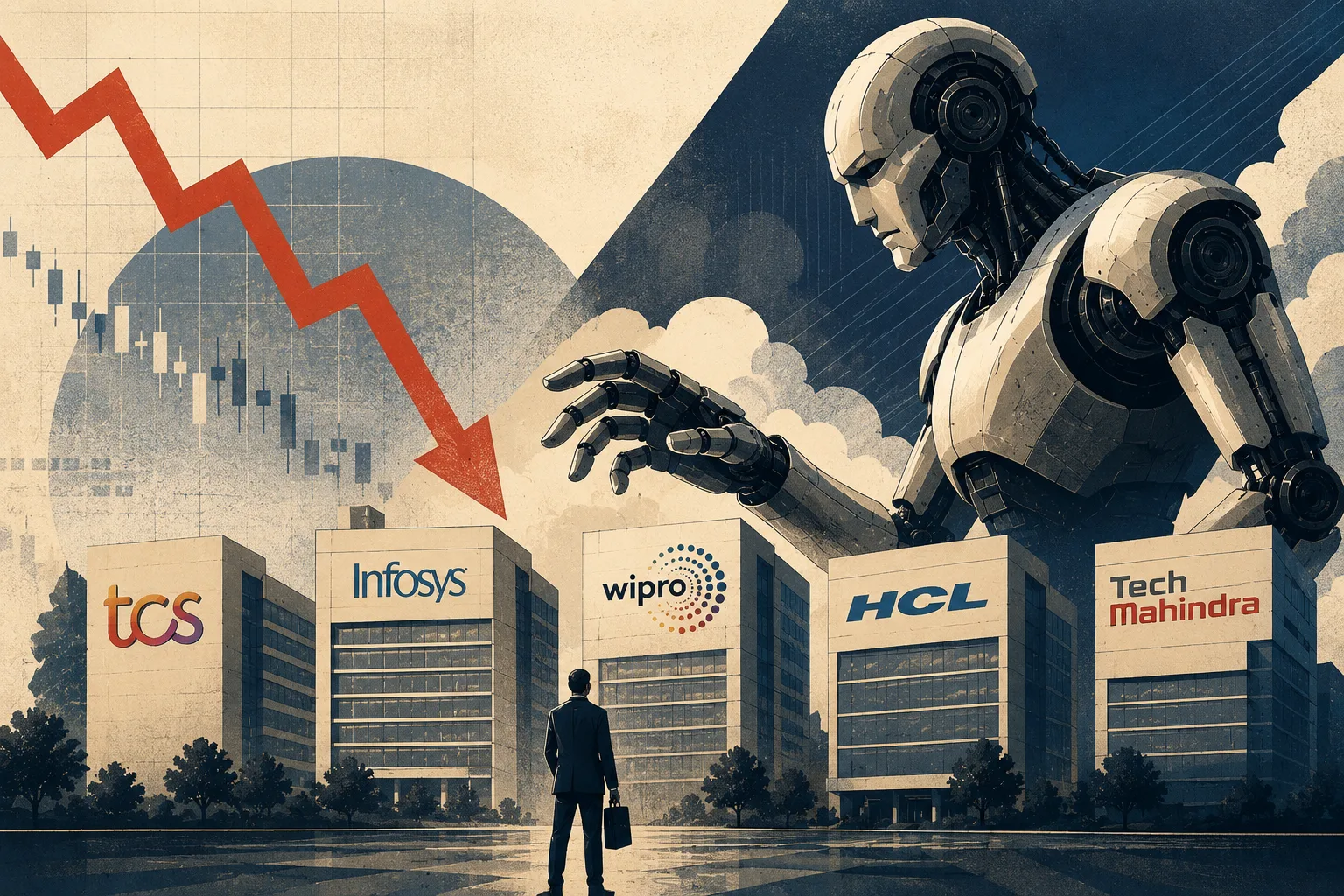
A Sector Under the Scanner
The Indian IT sector, long considered one of the steadiest performers in the equity market, has had a rough run through 2026. Stocks that once anchored large-cap portfolios, including Tata Consultancy Services (TCS), Infosys, Wipro, HCL Technologies, and Tech Mahindra, have all seen sharp corrections from their highs, and the sector has repeatedly shown up as the weakest link in the Nifty 50 on multiple recent trading sessions.
To put the scale of the move in perspective, the combined market capitalization of the top five IT companies has fallen by a substantial margin from its record levels in August 2024, wiping out a significant chunk of investor wealth built up over the preceding rally. This isn't a one-week dip; it is a sustained, multi-month re-rating of how the market is pricing IT sector stocks.
IT Sector Market Cap: A Dramatic Reversal

As the chart shows, the combined market capitalization of the top five IT names has now slipped to roughly the same level as Reliance Industries alone, a striking reversal from a couple of years ago, when Tata Consultancy Services was competing with Reliance for the top spot in India Inc.'s market-cap rankings.
What's Actually Driving the IT Stocks Selloff?
A few distinct threads have come together to create this pressure on IT sector stocks:
1. Weak global enterprise tech spending signals. A well-known global technology major's softer-than-expected quarterly update and cautious commentary on enterprise software spending sent a scare through the sector, since Indian IT companies derive a large share of their revenue from global clients in similar business lines.
2. Brokerage downgrades tied to structural concerns. Several global brokerages have downgraded ratings across large and mid-cap Indian IT names, citing concerns that go beyond a single quarter's numbers. The core worry: artificial intelligence could structurally shift the IT services business mix, pushing volumes away from traditional managed-services contracts and toward consulting and implementation work, a shift that could bring more cyclicality and require companies to rework their talent and delivery models.
3. Valuation resets. Some brokerages have also pointed out that even after sharp declines, Indian IT majors continue to trade at a meaningful premium to some of their global counterparts, suggesting that valuations may still have room to adjust further as growth expectations get reset.
4. Spillover from global tech corrections. When large global software and technology companies see sharp single-day declines, it tends to spill over into Indian IT stocks given the deep revenue linkages between the two markets.
Snapshot of the IT Sector Correction

This snapshot illustrates just how broad-based the correction has been; it isn't confined to one or two stocks. Nifty IT as an index, along with individual heavyweights and global peers, has all seen meaningful drawdowns over the course of the year.
The AI Question: Threat or Opportunity for IT Sector Stocks?
The heart of the current narrative around Indian IT stocks is artificial intelligence, and it cuts both ways. On one hand, there's a genuine and growing concern that AI-driven automation could reduce demand for some of the more routine, high-headcount services that have traditionally been the bread and butter of Indian IT, such as manual coding, testing, and support functions.
On the other hand, most large IT companies are actively repositioning themselves, investing heavily in AI capabilities, cloud services, and digital transformation offerings to stay relevant as client needs evolve. Whether this transition ultimately strengthens their competitive position or squeezes margins in the interim is the debate currently playing out in IT stock prices.
This tension between disruption risk and adaptation opportunity is likely to remain the defining theme for the sector over the next few years, and it's worth understanding both sides rather than reacting to headlines alone.
Reading the IT Stocks Selloff the Right Way
For investors watching this correction unfold, a few points are worth keeping in mind:
- Distinguish sentiment from fundamentals. Sharp single-day or single-week declines are often driven by sentiment and global cues as much as by company-specific news. It helps to separate short-term price action from actual changes in order books, deal pipelines and client commentary.
- Watch deal wins and management commentary closely. Quarterly earnings calls, large deal announcements and client spending trends offer a more direct read on business health than daily stock price moves.
- Track relative performance within the sector. Not all IT stocks are reacting identically; some names have corrected far more sharply than others, reflecting differences in exposure to at-risk service lines versus higher-value consulting and AI-linked work.
- Recognise that sector rotations are common. IT has historically gone through multi-year phases of outperformance and underperformance relative to the broader market. Understanding where the sector sits in that cycle adds useful context.
- Compare valuation multiples across peers. Looking at price-to-earnings and other valuation metrics relative to historical averages and global peers can help contextualise how much of the "AI risk" is already priced in.
Bottom line
The current IT sector correction is being shaped by a combination of near-term global cues and a longer-term structural question about how AI reshapes the technology services business. Both matter, but they operate on different timeframes. Near-term weakness driven by global spending signals can reverse quickly with a change in sentiment, while the structural AI question will likely play out over several years through changing deal structures, pricing models, and margins.
For anyone tracking IT stocks in India, the more useful exercise isn't predicting the next day's move but staying closely tuned to earnings quality, deal momentum, and how individual companies are adapting their business models to an AI-influenced world.
The information provided in this article is for educational and informational purposes only and should not be considered as an offer to buy or sell any securities or investment products. Investments in securities markets are subject to market risks; please read all related documents carefully before investing.
Frequently Asked Questions on IT Stocks in India
- Why are IT stocks falling in 2026?
The decline in Indian IT stocks stems from a combination of weak global enterprise technology spending signals, brokerage downgrades citing structural AI-related risks to the services business model, valuation resets, and spillover selling from global technology stock corrections.
- Is the fall in IT sector stocks a temporary correction or a structural shift?
It's likely a mix of both. Near-term weakness tied to global spending cues can reverse relatively quickly with a change in sentiment, while the structural question of how AI reshapes IT services delivery models is expected to play out gradually over several years.
- Which IT stocks have corrected the most in this cycle?
Reported drawdown snapshots have shown some mid-cap-oriented and consulting-heavy names correcting more sharply in percentage terms than some of the largest, more diversified IT majors, though the entire sector has seen broad-based weakness.