Recruiting has become a technology-driven business, but hiring teams still face many of the same operational problems they have dealt with for years. Recruiters spend time reviewing applications, responding to candidates, arranging interviews, updating applicant tracking systems, sending reminders, and searching for information. At the same time, candidates expect quick answers, convenient communication, and a hiring process that does not feel unnecessarily complicated.
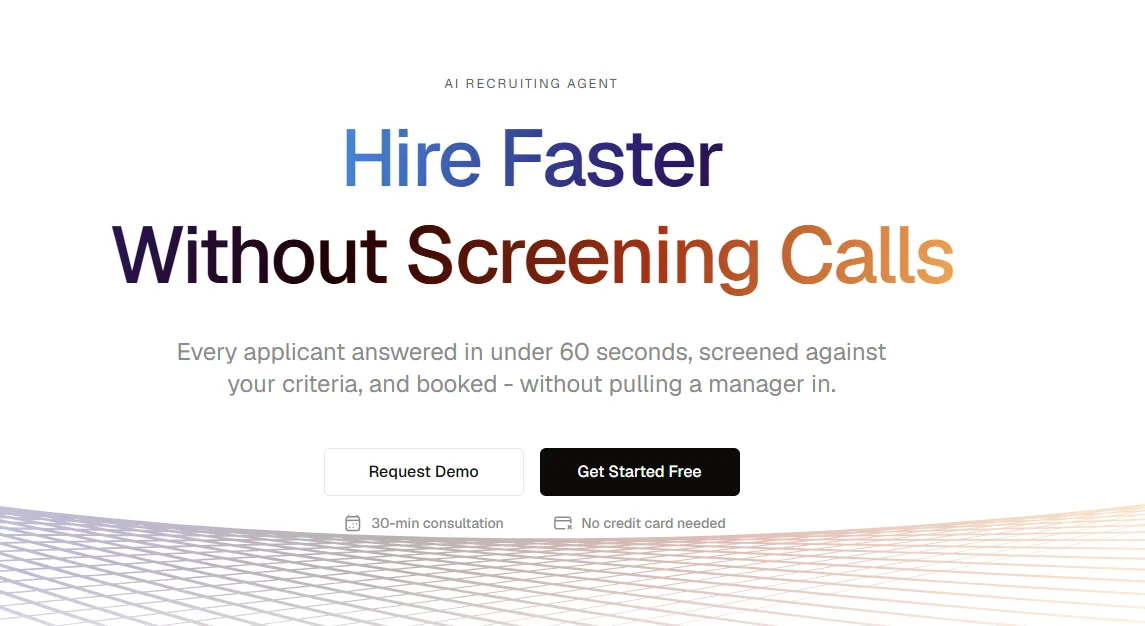
Artificial intelligence is changing how organizations approach these challenges. One of the most interesting developments is the emergence of the AI agent for recruiting. Rather than functioning only as a chatbot or a tool that performs one automated task, an AI agent can participate in a broader workflow. It can communicate with candidates, process information, trigger actions, and support recruiters across multiple stages of the hiring process.
The technology does not eliminate the need for recruiters. Instead, it creates an opportunity to move repetitive operational work away from people and give recruiting professionals more time for activities that require judgment and personal interaction.
What Makes an AI Recruiting Agent Different?
Recruiting software has existed for decades. Applicant tracking systems, resume databases, job boards, scheduling platforms, and automated email tools already handle many administrative processes.
So why is an AI agent different?
Traditional automation usually depends on clearly defined conditions. A company might create a workflow saying that when a candidate submits an application, an email should be sent. If the candidate passes a screening stage, another notification is triggered.
An AI agent can work with less rigid interactions.
It can interpret natural language, understand information from different sources, determine an appropriate next step within its assigned responsibilities, and interact with people throughout the process.
For example, a candidate might ask a question about working hours that is not covered by a simple button-based chatbot. A conversational recruiting agent can interpret the question, locate the relevant information available to it, and provide an answer.
If the candidate then wants to schedule an interview, the same agent can potentially continue the conversation and support the next step.
This continuity is one of the main differences between isolated automation and an agent-based workflow.
The Growing Complexity of Modern Recruiting
Modern hiring teams often operate across several channels simultaneously.
Candidates can arrive through company career pages, professional networks, employee referrals, recruitment agencies, job boards, social media, and direct outreach. Each source creates additional information that recruiters need to organize.
At the same time, hiring managers increasingly expect recruiting teams to move quickly.
A recruiter may be responsible for several open positions at once. Each position can have different requirements, different hiring managers, different interview processes, and different candidate pools.
The resulting workload is difficult to scale manually.
An AI agent for recruiting can provide an additional layer of capacity. Instead of requiring recruiters to manually manage every routine interaction, an agent can take responsibility for defined parts of the workflow.
This can be particularly valuable for organizations experiencing rapid hiring growth.
Candidate Pre-Screening
One of the most practical applications for an AI recruiting agent is pre-screening.
Recruiters can spend considerable time examining resumes and applications to determine whether candidates meet basic requirements. AI can help structure this information before a recruiter performs a deeper review.
A recruiting agent may be configured to identify information such as:
- Relevant work experience.
- Technical skills.
- Professional certifications.
- Education.
- Industry background.
- Location requirements.
- Availability.
- Responses to screening questions.
- Experience with specific tools or technologies.
The agent can organize candidates according to employer-defined criteria and flag information that requires further review.
This does not mean that an AI system should independently make consequential employment decisions. Human oversight remains important, particularly when candidate evaluation involves complex or ambiguous circumstances.
The strongest use case is often assistance rather than unrestricted decision-making.
Automating Candidate Questions
Recruiters answer many questions repeatedly.
Candidates may want to know:
- What does the interview process look like?
- How many interview stages are there?
- Is the position remote?
- What are the expected working hours?
- What benefits are available?
- What documents are required?
- How long does the hiring process usually take?
- When should candidates expect an update?
An AI agent can answer common questions using information approved by the organization.
This can make the recruitment experience more responsive without forcing recruiters to repeat the same explanations throughout the day.
There is also an important benefit for international recruiting. Candidates may be located in different time zones and may submit questions outside conventional office hours.
An AI recruiting agent can provide initial assistance at any time while escalating more complicated issues to a human recruiter.
Interview Scheduling Without Endless Emails
Interview coordination is another task that looks simple until multiple people become involved.
A recruiter may need to find a time that works for the candidate, hiring manager, interviewer, and sometimes several additional participants.
Rescheduling makes the problem even more complicated.
An AI agent can support this process by communicating with candidates, collecting availability, following scheduling rules, and initiating the appropriate calendar actions.
For example, instead of a recruiter manually sending several messages, the candidate could interact with an agent that presents available options.
If the candidate needs to change the appointment later, the agent can handle the initial request and update the workflow according to the organization's rules.
This is a good example of where agentic technology can provide value beyond text generation.
The system is helping complete an actual process.
Recruiting Outreach at Scale
Sourcing passive candidates can be one of the most time-consuming activities in talent acquisition.
Recruiters may identify potentially relevant professionals and then create personalized outreach messages. When this process is repeated hundreds of times, it can consume a significant amount of working time.
An AI agent can help recruiters prepare personalized communication based on approved information.
For example, the agent can incorporate relevant professional experience into an outreach message while maintaining the employer's preferred communication style.
However, automation should not mean sending generic messages to as many people as possible.
Effective recruiting outreach depends on relevance. Candidates are more likely to engage with communication that clearly explains why the opportunity may be relevant to their background.
AI should therefore support personalization rather than simply increase message volume.
Follow-Ups and Candidate Engagement
Candidates can easily disappear from a recruiting pipeline because of missed messages, incomplete forms, or delayed responses.
Recruiters may want to follow up but have limited time to monitor every candidate manually.
An AI recruiting agent can assist by identifying situations where an action is required.
For example, it could recognize that:
- A candidate has not completed a required step.
- An interview confirmation is missing.
- Additional information has been requested.
- A candidate has not responded to a scheduling message.
- A follow-up is due after an interview.
The agent can then initiate an approved communication.
This creates a more consistent recruiting process while reducing the number of small administrative tasks recruiters must remember.
AI Agents and Applicant Tracking Systems
An AI agent does not necessarily need to replace an organization's existing recruiting infrastructure.
In many cases, integration is more practical.
Companies may already have an applicant tracking system containing years of candidate information and established workflows. Replacing such a system can be expensive and disruptive.
An AI agent can instead work alongside existing tools.
The ATS can remain the central repository for candidate records while the agent assists with communication, organization, scheduling, and workflow execution.
This model can also make implementation easier because the organization does not need to rebuild its entire recruiting operation around a new platform.
Supporting Hiring Managers
Recruiting technology is often designed primarily around recruiters, but hiring managers can also benefit from AI-assisted workflows.
Hiring managers may receive large numbers of candidate profiles and interview feedback. Finding the most relevant information can take time.
An AI agent can help organize information into concise summaries.
For example, before a hiring manager speaks with a candidate, the agent could prepare a structured overview covering:
- Relevant experience.
- Key qualifications.
- Screening responses.
- Interview stage.
- Outstanding questions.
- Previous interviewer feedback.
The hiring manager can then spend more time preparing for the actual conversation instead of searching through multiple systems.
Improving the Candidate Experience
Recruiting is not only an internal business process. It is also a customer-like experience for candidates.
A slow hiring process can cause candidates to lose interest. Lack of communication can create uncertainty. Repeatedly asking candidates for information they have already provided can make the organization appear disorganized.
AI agents can help create more consistent communication.
For example, a candidate can receive an immediate confirmation after applying. The agent can explain what happens next and answer basic questions.
During the process, the system can provide reminders and updates when appropriate.
But automation should be designed carefully.
Candidates should not feel as though they are communicating with an impersonal system at every stage. Important conversations, sensitive situations, negotiations, and complex questions should remain accessible to human professionals.
The objective is to combine speed with a human-centered experience.
Cogniagent and Agent-Based Recruiting
The growing interest in recruiting agents is part of a broader transition toward AI systems that can perform multi-step workflows.
Cogniagent is an example of a platform built around cognitive AI agents rather than traditional chatbot functionality alone. Its approach combines conversational AI agents, autonomous agents, and deterministic automation.
That combination can be relevant to recruiting because hiring processes require different types of automation.
Some interactions are conversational. Candidates may ask questions in natural language.
Other tasks are procedural. A specific candidate may need to be moved to the next stage after completing defined requirements.
Still others require autonomous workflow management, such as monitoring outstanding actions and initiating appropriate follow-ups.
A platform such as Cogniagent can be considered by organizations looking at AI agents not simply as communication tools but as components of broader business workflows.
AI Agent for Recruiting and Remote Hiring
Remote and hybrid work have expanded the geographic reach of many recruiting teams.
A company can recruit candidates across cities, countries, and time zones. This creates additional scheduling and communication challenges.
An AI agent can provide a consistent first layer of interaction regardless of where a candidate is located.
It can collect information, explain the process, coordinate scheduling, and provide routine updates.
This can be particularly useful for organizations with distributed recruiting teams.
Instead of relying entirely on one recruiter to respond to every candidate interaction, the organization can establish a consistent automated process while keeping human recruiters responsible for important decisions.
Multilingual Recruiting
International hiring also creates language challenges.
An AI recruiting agent can potentially communicate in multiple languages, depending on the technology and configuration used by the organization.
This can make the initial stages of recruitment more accessible to candidates who are not comfortable communicating exclusively in the employer's primary language.
However, organizations should verify the quality and accuracy of AI-generated communication before using it in important employment contexts.
Incorrect translations or culturally inappropriate wording can negatively affect candidate experience.
Human review remains useful when communication involves complex contractual, legal, or sensitive information.
Security and Data Governance
Recruiting systems process personal information, so security should be treated as a fundamental requirement.
Before introducing an AI agent, organizations should understand what information the system can access and what it is permitted to do.
Important considerations include:
- Access controls.
- Data retention.
- Authentication.
- Audit logs.
- Integration permissions.
- Candidate privacy.
- Human approval requirements.
- Data processing policies.
- Security monitoring.
Organizations should also establish boundaries around autonomous actions.
For example, an AI agent may be allowed to schedule interviews automatically but require human approval before changing a candidate's status in a consequential way.
Clear permissions can help companies capture the benefits of automation without giving an AI system unnecessary authority.
Measuring Recruiting Agent Performance
Companies should not introduce AI simply because it is a popular technology.
There should be measurable objectives.
Recruiting teams can track several indicators before and after implementation.
Time saved
How much recruiter time is spent on repetitive communication, scheduling, and administration?
Response speed
How quickly do candidates receive answers to routine questions?
Scheduling efficiency
How long does it take to arrange interviews?
Candidate completion
Do more candidates complete required steps when automated assistance is available?
Recruiter workload
Are recruiters able to manage more candidates without increasing administrative hours?
Escalation frequency
How often does the AI agent need human intervention?
These measurements can help determine which parts of the workflow should be automated further and which should remain primarily human-driven.
Common Challenges of AI Recruiting Agents
Despite their potential, AI agents are not a universal solution.
One challenge is inaccurate information. If an agent receives outdated job descriptions or incorrect company information, it can communicate incorrect details to candidates.
Another challenge is over-automation.
Recruiting is inherently interpersonal. A process that automates every interaction may become efficient but unpleasant.
There is also the challenge of bias and fairness. AI-assisted recruiting systems need careful monitoring to ensure that their processes do not create inappropriate disadvantages for candidates.
Finally, integration can be difficult. An agent that cannot access the necessary systems or cannot reliably execute actions may provide little value.
For these reasons, implementation should begin with clearly defined use cases rather than attempting to automate the entire recruitment department at once.
The Future of AI-Powered Recruitment
The next phase of recruiting technology is likely to involve increasingly interconnected AI agents.
Instead of one AI system performing one task, organizations may develop workflows in which specialized agents work together.
One agent could support candidate communication. Another could help with sourcing. Another could coordinate scheduling. A separate system could assist with internal summaries and reporting.
These agents can operate within defined organizational rules while human recruiters retain control over important decisions.
This model could transform recruiting operations from a collection of disconnected tools into a more coordinated environment.
The technology is still evolving, but the direction is clear: AI is moving from generating content toward performing actions.
Conclusion
The AI agent for recruiting is becoming an important concept in the evolution of talent acquisition technology.
Instead of limiting artificial intelligence to resume analysis or chatbot conversations, organizations can use agent-based systems to support complete workflows involving candidate communication, screening assistance, scheduling, outreach, follow-ups, and recruiter administration.
The biggest opportunity is not necessarily replacing recruiters. It is reducing the repetitive workload that prevents recruiters from spending enough time on candidates and hiring managers.
Platforms such as Cogniagent demonstrate how conversational AI, autonomous agents, and deterministic automation can be combined to support complex workflows.
For organizations considering this technology, the most practical approach is to start with specific, measurable processes. Candidate FAQs, interview scheduling, follow-ups, information collection, and administrative coordination are natural areas to explore.
Recruiting will continue to depend on human judgment and relationships. AI agents can provide the operational support around those relationships, helping hiring teams build processes that are faster, more consistent, and easier to scale while keeping people at the center of important employment decisions.