Introduction
Every year, thousands of workplace injuries, cardiac emergencies, and accidents happen across Dubai's offices, factories, and construction sites — and in the first few minutes, it's rarely a doctor who's present. It's a colleague, a supervisor, or a family member. Adult First Aid Training prepares you to be that person: someone who can recognize an emergency, act with confidence, and keep a situation from getting worse before professional help arrives.
At Al Maha Gulf Technical & Occupational Skills Training, our KHDA-approved Adult First Aid course is built for exactly this — real people, real workplaces, real emergencies. In this guide, we'll cover what the course involves, who needs it, why certification matters in the UAE, and how to choose the right training provider in 2026.
What Is Adult First Aid Training?
Adult First Aid Training is a certified program that teaches participants how to assess and respond to medical emergencies involving individuals aged 12 and above. Unlike pediatric first aid, which focuses on infants and young children, adult first aid training covers the specific techniques, considerations, and equipment used when helping an adult casualty.
A typical course covers:
- Primary and secondary survey — how to assess a casualty safely
- CPR (Cardiopulmonary Resuscitation) for adults
- AED (Automated External Defibrillator) use in cardiac emergencies
- Choking response for conscious and unconscious adults
- Bleeding control and wound management
- Shock recognition and management
- Burns, fractures, and sprains
- Recovery position and unconsciousness management
- Workplace-specific hazards (chemical exposure, heat stress, machinery injuries)
Most programs run between 4–8 hours, depending on accreditation level, and result in a certificate valid for 2–3 years.
Who Needs Adult First Aid Certification in Dubai?
- HR teams and corporate employees — UAE labor law and insurance requirements increasingly expect at least one certified first aider per department or floor
- Facility and site supervisors—construction, warehousing, and industrial sites need trained first responders on every shift
- Hospitality and retail staff — hotels, malls, and restaurants deal with the public daily and are legally encouraged to have trained staff
- Fitness professionals and gym trainers — cardiac events during exercise are a recognized risk
- Drivers and fleet staff — road accident response is a core requirement for transport companies
- General public — parents, caregivers, and anyone who wants the confidence to help in an emergency
Why KHDA Approval Matters
Not all first aid certificates carry equal weight in the UAE. A KHDA-approved certification signals that the training center meets Dubai's Knowledge and Human Development Authority's quality standards for content, trainer qualification, and assessment rigor. This matters for three practical reasons:
- Compliance — Many employers, tenders, and insurance policies specifically require KHDA-recognized certificates, not just "any" first aid certificate.
- Renewal and portability — KHDA-approved certificates are more easily recognized across government and private sector employers in Dubai.
- Quality assurance — KHDA approval means the training center has been audited for curriculum quality, not just marketing claims.
Always confirm accreditation before booking — ask the provider directly whether the certificate is KHDA-approved, and whether it's also recognized by bodies like DCAS (Dubai Corporation for Ambulance Services) or Dubai Civil Defense, depending on your industry.
What Happens During the Course? A Step-by-Step Look
1. Scene safety and assessment Before touching a casualty, participants learn the DRSABC approach — Danger, Response, Send for help, Airway, Breathing, Circulation. This structured approach prevents panic and ensures the responder doesn't become a second casualty.
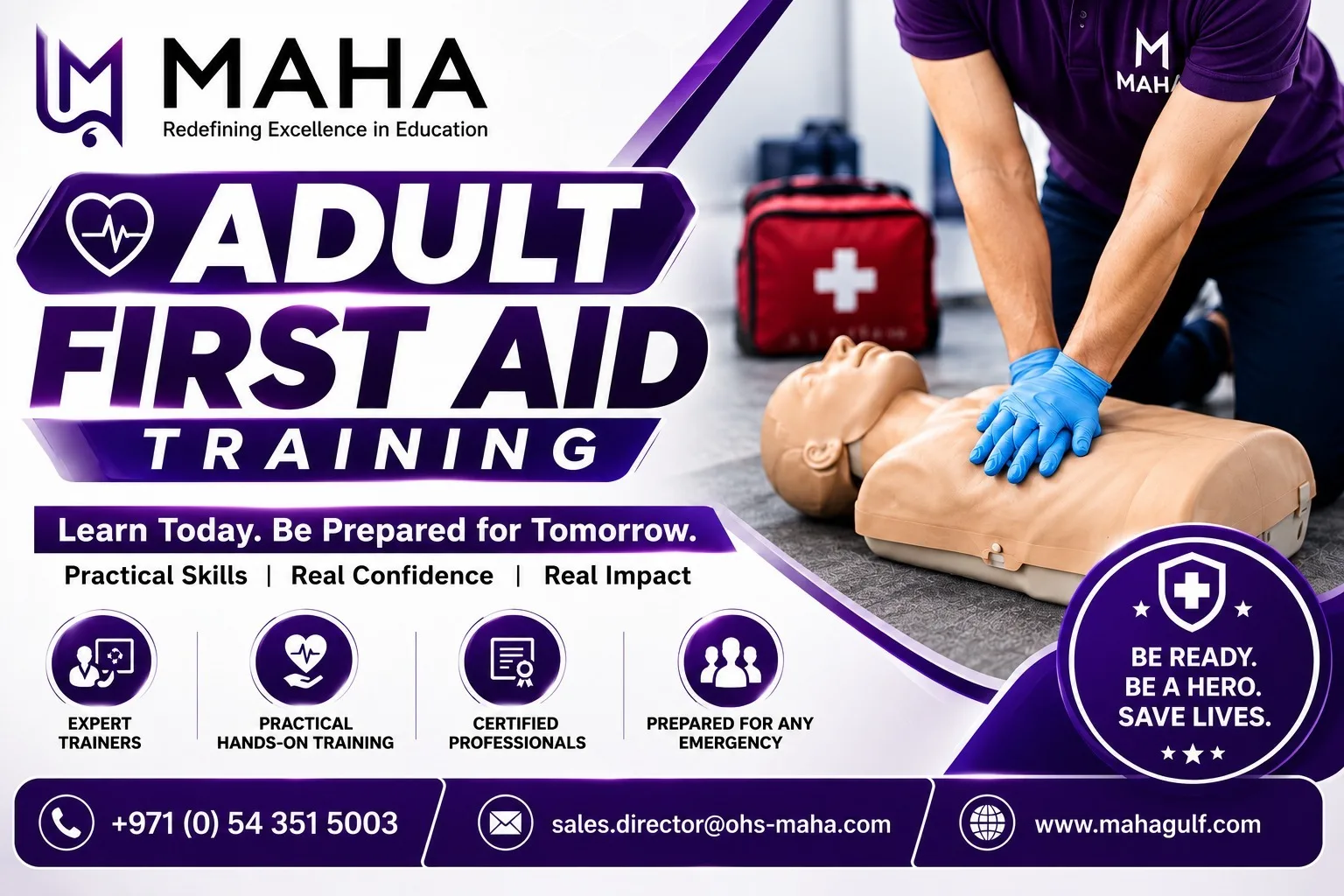
2. Hands-on CPR practice Using manikins, trainees practice chest compressions and rescue breaths at the correct rate and depth, based on current international resuscitation guidelines.
3. AED simulation Trainees use a training AED unit to understand pad placement, voice prompts, and safety checks — critical because AEDs are now present in many UAE malls, offices, and metro stations.
4. Scenario-based practice Realistic scenarios — a colleague collapsing in a meeting, a warehouse worker cutting their hand, a choking incident at a work lunch — are used to build muscle memory and decision-making speed.
5. Assessment and certification A practical skills check and short theory assessment confirm competency before the certificate is issued.
Adult First Aid vs. Other First Aid Courses: Quick Comparison
Course TypeBest ForTypical DurationFocus Age GroupAdult First Aid & CPR/AEDCorporate staff, general public4–8 hours12 years and abovePediatric First AidNannies, teachers, childcare staff6 hoursInfants and childrenWorkplace First Aid (Emergency First Aid at Work)Designated workplace first aiders1 dayAdults, workplace-specificBasic Life Support (BLS)Healthcare professionals4–6 hoursAdults, clinical settingIf you're unsure which course fits your role, our team at Al Maha Gulf can help you pick the right qualification based on your industry and job requirements.
How to Choose the Right First Aid Training Provider in Dubai
When comparing training centers, ask these questions:
- Is the certificate KHDA-approved and internationally recognized?
- Are trainers certified instructors with real emergency response or clinical backgrounds?
- Is there hands-on practice with manikins and AED units, not just slides?
- What's the class size — smaller groups mean more individual practice time?
- Is there flexible scheduling (weekday, weekend, or corporate on-site options)?
- Does the provider offer corporate group bookings with tailored scenarios for your industry?
Why Choose Al Maha Gulf for Adult First Aid Training
Al Maha Gulf Technical & Occupational Skills Training is a KHDA-approved training center based in Dubai, specializing in occupational health, safety, and workplace skills courses. Our Adult First Aid Training program is designed specifically around real UAE workplace scenarios — from office environments to industrial sites — and delivered by certified trainers with practical emergency response experience.
We keep batch sizes small so every participant gets real hands-on time with CPR manikins and AED units, and we offer both public batches and dedicated corporate group training at your premises.
Ready to get certified? [Enquire about upcoming Adult First Aid Training batches →]
Frequently Asked Questions
Q: How long is an Adult First Aid certificate valid in Dubai? Most certifications are valid for 2–3 years, after which a refresher course is required to stay current with updated guidelines.
Q: Do I need any prior medical knowledge to join? No. The course is designed for beginners and requires no prior medical background.
Q: Is this course mandatory for businesses in the UAE? Many UAE employers are required to have a minimum number of trained first aiders on-site, particularly in industries like construction, hospitality, and manufacturing. Check with your industry regulator or HSE consultant for specific requirements.
Q: Can this course be done as a corporate group session? Yes — we offer on-site and in-house corporate batches for teams of any size, with content tailored to your specific work environment.
Q: What's the difference between Adult First Aid and CPR-only training? CPR-only training focuses solely on cardiac arrest response, while Adult First Aid covers a broader range of emergencies including bleeding, burns, fractures, choking, and shock, in addition to CPR and AED use.
Al Maha Gulf Technical & Occupational Skills Training L.L.C. is a KHDA-approved training center in Dubai. [+971 54 351 5003] to book your Adult First Aid Training seat or arrange a corporate batch.