Chemistry problems often feel difficult not because one formula is impossible, but because several small decisions must be made in the right order. A reliable framework turns uncertainty into a sequence of checks. The goal is to identify what is known, choose the scientific relationship that connects it to the unknown, and verify that the result makes physical sense.
Start by translating the question
Before using a calculator, rewrite the prompt in three lines: the quantity you need, the information you have, and the conditions that matter. Include units immediately. If a problem gives 5.0 grams of sodium chloride and asks for moles, the target is an amount in moles, the known quantity is mass, and the connecting property is molar mass. This translation prevents a common mistake: choosing a familiar equation before understanding the requested output.
Write symbols next to each value. Mass can be m, amount can be n, concentration can be c, and volume can be V. Symbols expose missing information and show whether a conversion is needed before substitution.
Use units as part of the reasoning
Units are not decoration added at the end. They are a map of the calculation. For the sodium chloride example, multiplying grams by moles per gram must leave moles. If grams remain in the final unit, the setup is incomplete. Dimensional analysis is especially useful in gas laws, solution calculations, and multi-step stoichiometry because it reveals inverted conversion factors.
Keep conversion factors visible rather than doing them mentally. A chain from grams to moles to moles of product to grams of product shows exactly where each chemical relationship enters. It also makes the answer easier to audit.
Balance reactions before calculating
Stoichiometric coefficients describe ratios between particles and moles. They are trustworthy only after the chemical equation is balanced. Count atoms on both sides, then adjust coefficients without changing subscripts. Begin with species that appear in only one reactant and one product, and usually leave hydrogen and oxygen until later when they occur in several compounds.
After balancing, recount every element and reduce the coefficients to the smallest whole-number ratio. A carefully organized calculation based on an unbalanced equation still produces the wrong answer.
Separate formulas from arithmetic
Write the general relationship before inserting numbers. For molarity, write c = n/V. For an ideal gas, write PV = nRT. Rearrange symbolically so the desired variable is isolated, and only then substitute measured values. This reduces calculator errors and clarifies why each number belongs in the expression.
Carry one or two extra digits during intermediate steps. Round only the final result according to the precision supported by the original measurements. If the question expects significant figures, state them deliberately instead of letting a calculator display determine the answer.
Check the result from three directions
A final answer should pass a unit check, a magnitude check, and a chemistry check. The unit must match the requested quantity. The magnitude should be plausible: a dilute classroom solution is unlikely to have a concentration of thousands of moles per liter. The chemistry should fit the situation. Mass cannot be created in a closed reaction, and a limiting reagent should not produce more product than an unlimited supply would allow.
Estimate before calculating whenever possible. Even a rough prediction helps catch misplaced decimals and incorrect metric prefixes.
Use AI as an explanation partner
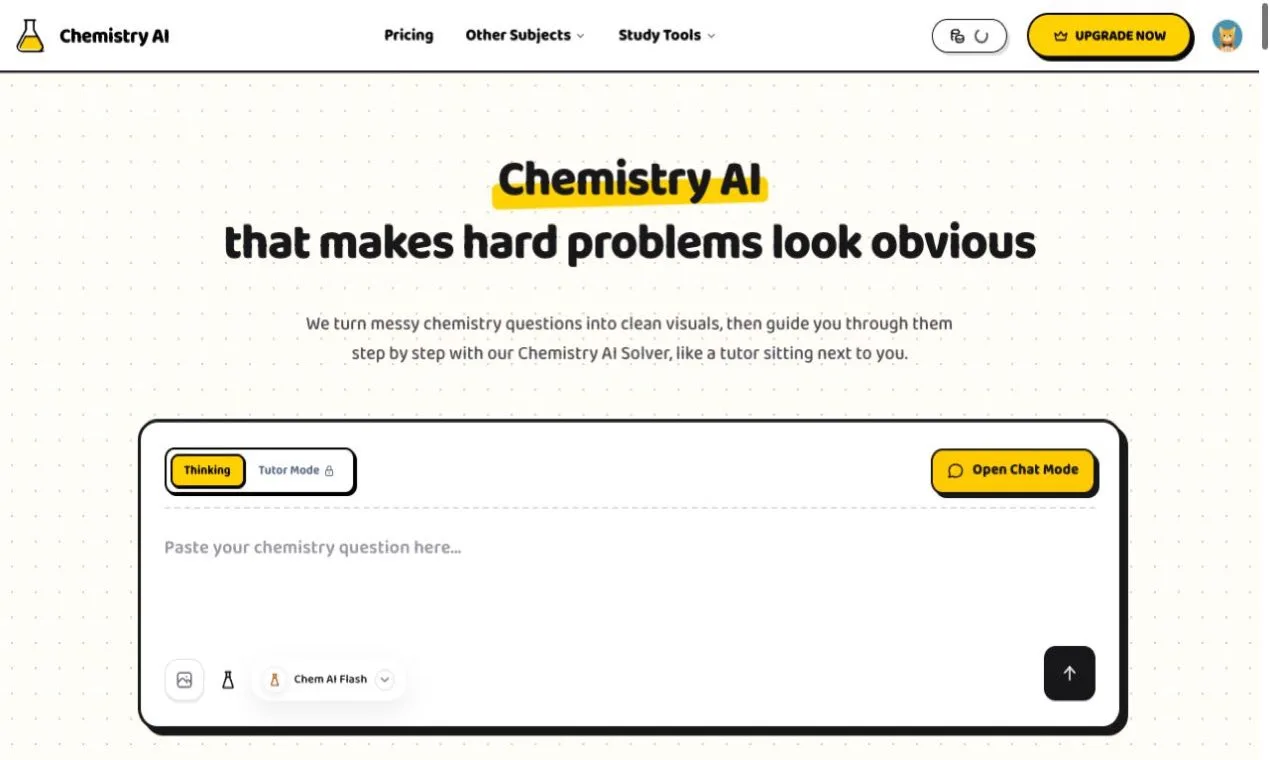
AI is most valuable when it reveals intermediate reasoning rather than returning only a number. Chemistry AI at https://chemistryai.chat/ helps students work through equations, formulas, uploaded questions, and step-by-step explanations. The best practice is to compare each explanation with the framework above: identify the knowns, inspect the equation, trace the units, and test the final result.
Ask focused follow-up questions. Instead of asking whether an answer is correct, ask why a conversion factor is oriented that way, which assumption permits a gas-law equation, or where charge conservation appears in a redox step. Focused questions turn an AI response into an active learning exercise.
Build a reusable solution template
For future work, use the same six-part structure: state the target, list known values with units, write the balanced reaction when relevant, select and rearrange the relationship, calculate with visible units, and perform the three final checks. Add one sentence interpreting the result in context.
Consistency matters more than speed at first. After several problems, the framework becomes automatic. Students then spend less attention organizing work and more attention on chemical ideas. That is the advantage of a step-by-step method: it makes mistakes easier to locate, explanations easier to communicate, and unfamiliar questions less intimidating.
Explore Chemistry AI
Useful resource:
Useful resource: https://chemistryai.chat/