
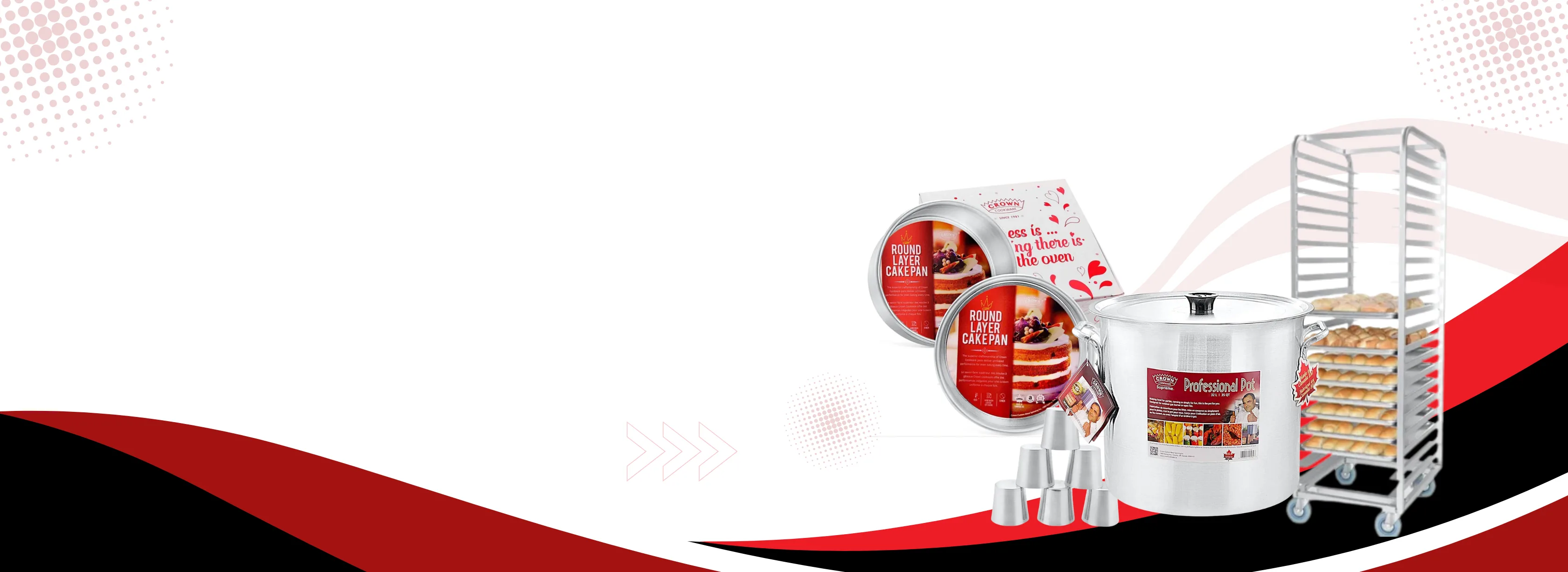
High-volume bakery operations demand commercial cookware that withstands continuous production cycles without distortion or hot spots. Procurement leads evaluating new pans, racks, and fabricated tools need a clear framework, one that weighs material integrity, thermal behaviour, menu fit, lifecycle care, and supplier credibility. The factors below are ordered for procurement decisions and guide facility upgrades from initial spec through long-term operational return.
1. Assess Material Durability in Commercial Cookware
Durability separates a pan that survives years of oven rotation from one that cups, twists, or fatigues within a single season. Heavy-gauge virgin aluminum, the core stock used across Crown Cookware production, resists warping under continuous thermal loading and absorbs handling shock from busy decks and racks.
Welded joints on bakery racks and reinforced rims on cake, pizza, and round pans carry the bulk of the mechanical stress. Specifying a reinforced structure up front avoids the slow drift toward premature failure that drains capital budgets.
Procurement checklist:
- Confirm the aluminum gauge suits the bake schedule
- Verify rim reinforcement on high-handling pans
- Inspect bakery rack welds at every joint, not only corners
- Request material traceability for virgin food-grade stock
2. Verify Thermal Consistency in Your Commercial Cookware
Thermal behaviour decides batch uniformity. Pans that hold uneven temperatures produce inconsistent crumb, colour, and crust, the most visible quality complaints in any production bakery. Uncoated virgin aluminum conducts heat more responsively than heavier alternatives, which is why it remains the preferred substrate for commercial cookware on high-turnover decks.
Quick recovery after door openings matters as much as initial distribution. Rapid rebound shortens cycle gaps and protects scheduled output when ovens load and unload frequently.
Selection signals worth weighing:
- Best for: continuous baking with frequent door cycles
- Not for: induction only lines without compatible bases
- Cost posture: moderate upfront, lower lifetime spend through stable performance
Spec sheets that detail base flatness and wall thickness reveal far more than glossy product images.
3. Match Commercial Kitchen Cookware to Menu Needs
Menu architecture should drive equipment selection, not the reverse. A pastry programme needs different pan geometries than a pizza or artisan bread line, and commercial kitchen cookware specified without that fit forces operators to compromise on output or quality.
Pan shape governs crust development, release, and stacking efficiency. Sheet sizing must align with proofing cabinets, oven decks, and bakery rack pitch; workflow stalls at every transfer point. Crown Cookware supports menu-driven specification through cake pans, pizza pans, round pans, pots, and metal spun forms produced to bakery dimensional requirements.
Questions to ask before ordering:
- Do current rack pitches match the proposed pan stack?
- Which products run daily versus weekly, and at what scale?
- Where do bottlenecks appear during peak shifts?
4. Evaluate Maintenance Protocols for Commercial Cookware
Care discipline determines whether pans deliver a long service life or degrade within a few seasons. Uncoated aluminum responds well to neutral cleaning agents and soft brushes; abrasive pads and caustic detergents strip the natural oxide layer and accelerate surface pitting on commercial cookware.
Storage shapes structural life as much as washing. Pans nested unevenly or racks loaded against walls develop slow bowing that no reconditioning can fully reverse.
Practical maintenance signals:
- Use neutral pH cleaners, never harsh caustics
- Air dry fully before stacking to prevent oxidation marks
- Store bakery racks upright on level flooring
- Rotate pans through stations to balance wear
Ignoring these routines does not cause immediate failure; it quietly compounds replacement spend across every quarter.
5. Choose a Reliable Commercial Kitchen Manufacturer
Supplier choice locks in every prior factor. A commercial kitchen manufacturer that fabricates in-house controls material sourcing, gauge consistency, weld quality, and dimensional tolerance, the variables that quietly determine whether a bakery rack survives a decade of loading or warps within a season.
Crown Cookware produces pots, bakery racks in multiple welded sizes, cake pans, pizza pans, and round pans from virgin food-grade aluminum, with metal spinning capability for custom geometries. Direct sourcing avoids the markup and quality drift introduced by intermediaries.
Buyers upgrading facilities should request a custom quote from Crown Cookware to confirm specifications, lead times, and bakery rack configurations before the next production cycle locks in legacy equipment limitations.