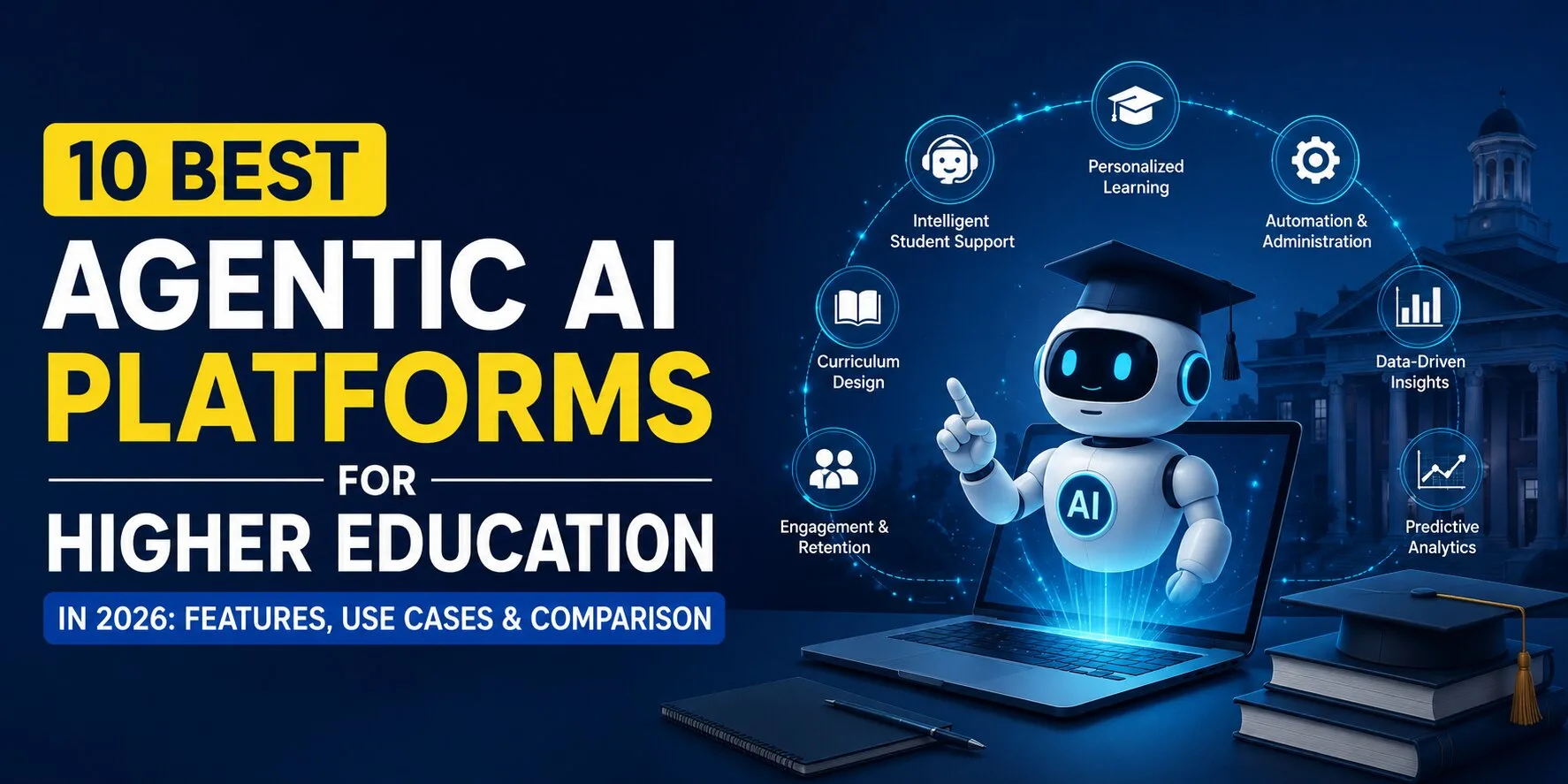
Higher education is moving beyond traditional chatbots and generative AI assistants toward agentic AI—systems that can understand context, make decisions, use institutional data, and take action across workflows.
Universities are exploring AI agents for admissions, student support, advising, retention, academic services, career services, and administrative operations. Research on agentic AI in higher education also highlights the growing need for integrated, multi-agent ecosystems rather than isolated AI tools.
Below are 10 notable agentic AI platforms to consider in 2026.
What Is an Agentic AI Platform for Higher Education?
Unlike a conventional chatbot that primarily responds to questions, an agentic AI platform can reason through tasks, access relevant systems, coordinate multiple steps, and execute actions based on defined goals and permissions.
For example, an admissions agent could identify an incomplete application, check required documents, notify the applicant, update the CRM, and escalate exceptions to an admissions counselor.
Key capabilities to evaluate
When comparing platforms, universities should consider:
- AI agent orchestration
- CRM, SIS and LMS integrations
- Student lifecycle automation
- Personalized engagement
- Data governance and security
- Human-in-the-loop controls
- Workflow automation
- Analytics and reporting
- Scalability
- Higher-education-specific functionality
10 Best Agentic AI Platforms for Higher Education in 2026
1. Talisma
Best for: End-to-end student lifecycle and institutional intelligence
Talisma is an AI-native platform focused on higher education and other complex organizations. Its higher-education offering combines AI strategy, data foundations and Forward Deployment Agents designed around specific institutional workflows.
Its agents can support areas such as application verification, transcript processing, admissions, advising, financial aid, registration, retention outreach, career services and compliance.
Key features:
- Higher-education-focused AI agents
- Admissions and application automation
- Student retention and engagement
- CRM, SIS and LMS connectivity
- Unified institutional data
- AI strategy and governance
- Workflow automation
Best suited for: Universities looking to connect AI with existing institutional systems and automate processes across the student lifecycle.
2. Salesforce Agentforce for Education
Best for: Universities already using Salesforce
Salesforce has expanded its agentic capabilities into higher education through Agentforce. A recent example is REVA University’s REVAion platform, which uses Agentforce for Education, Marketing and Agentforce 360 to support personalized engagement across the student lifecycle.
Key features:
- AI agents
- CRM integration
- Marketing automation
- Student engagement
- Workflow automation
- Analytics
Best suited for: Institutions already invested in the Salesforce ecosystem.
3. Google Gemini Enterprise for Education
Best for: Enterprise AI and custom institutional agents
Google's Gemini Enterprise for Education provides a platform for building and deploying AI capabilities across an institution. In 2026, Tambellini recognized Gemini Enterprise for Education as a "Commander" in its AI Agents for Administrative Efficiency assessment.
Key features:
- Gemini-powered AI
- Custom AI services
- Agent development
- Enterprise data integration
- Administrative automation
- Security and governance
Best suited for: Universities seeking a flexible enterprise AI foundation.
4. Element451 Bolt
Best for: Admissions and student lifecycle engagement
Element451 launched Bolt as a standalone AI agent platform in 2026. The platform is designed specifically for higher education and can work alongside existing CRM or student information systems. The company reported more than 60 million AI-powered student journeys at institutions using Bolt.
Key features:
- AI student engagement
- Admissions automation
- Recruitment support
- Student lifecycle workflows
- CRM/SIS compatibility
- AI-powered communication
Best suited for: Institutions prioritizing recruitment, enrollment and student engagement.
5. Risely AI
Best for: Cross-campus operational automation
Risely positions itself as an agentic AI platform for higher education that connects institutional data from systems such as SIS, LMS and CRM platforms. Its agents focus on enrollment, student retention and other campus relationships.
Key features:
- Enrollment agents
- Retention support
- Institutional data integration
- AI workflow automation
- Cross-campus intelligence
Best suited for: Universities looking to automate operational workflows using existing institutional data.
6. Microsoft Copilot Studio
Best for: Building custom AI agents
Microsoft Copilot Studio can be considered when an institution wants to develop customized agents connected to its Microsoft ecosystem.
Key features:
- Custom agent creation
- Workflow automation
- Microsoft ecosystem integration
- Knowledge-grounded responses
- Enterprise governance
Best suited for: Universities heavily invested in Microsoft 365, Azure and Power Platform.
7. StackAI
Best for: Building AI workflows and agents
StackAI focuses on creating AI-powered workflows and agents for organizational use cases. In higher education, potential applications include student support, document processing, knowledge retrieval and administrative automation.
Key features:
- AI workflow builder
- Agent development
- Knowledge retrieval
- Workflow automation
- Enterprise integrations
Best suited for: Institutions that want flexibility to build specialized AI workflows.
8. Cogniti
Best for: Educator-designed learning agents
Cogniti focuses more directly on teaching and learning. The University of Melbourne is piloting Cogniti in 2026, highlighting its ability to let educators create AI agents using plain-language instructions, subject resources and guardrails.
Key features:
- No-code AI agents
- Educator-controlled configuration
- Subject-specific knowledge
- Learning support
- LMS integration
Best suited for: Universities exploring AI agents for teaching and learning.
9. UniAI
Best for: AI-powered university transformation
UniAI positions itself as an agentic university platform built around multiple AI-powered modules covering admissions, academics, careers, placements and alumni engagement.
Key features:
- AI admissions support
- Academic assistance
- Career preparation
- Placement support
- Alumni engagement
- Integrated student journey
Best suited for: Institutions seeking a broader AI platform spanning multiple university functions.
Top Agentic AI Use Cases in Higher Education
1. Admissions Automation
AI agents can answer prospective student questions, qualify inquiries, verify documents, schedule follow-ups and identify applicants requiring human intervention.
2. Student Retention
Agents can identify risk signals and initiate personalized outreach before a student disengages.
3. Academic Advising
AI can help students understand course requirements, registration options, academic policies and available support.
4. Financial Aid Support
Agents can answer common financial-aid questions, identify missing information and guide students through processes.
5. Student Service Automation
Routine requests involving registration, transcripts, policies and campus services can be automated while complex cases are escalated to staff.
6. Career Services
AI agents can support resume preparation, job matching, interview preparation and employer engagement.
7. Compliance and Accreditation
Agents can help gather documents, organize evidence, identify missing information and support reporting workflows.
How to Choose the Right Agentic AI Platform
The "best" platform depends on your institution's priorities. Before purchasing, evaluate the following:
1. Start with business outcomes: Identify measurable problems such as application processing time, enrollment conversion, student retention or administrative workload.
2. Check integration capabilities: Your AI platform should work with systems such as your CRM, SIS, LMS and ERP rather than creating another silo.
3. Evaluate data readiness: Agentic AI depends heavily on reliable, connected institutional data. Talisma, for example, positions OneData as the data foundation supporting its higher-education agents.
4. Prioritize governance: Review permissions, security, privacy, auditability and human-approval controls before deploying autonomous workflows.
5. Measure ROI: Define KPIs before implementation, including response time, cost-to-serve, application completion, enrollment yield, retention and staff productivity.
Final Thoughts
Agentic AI is becoming an important part of the next generation of higher-education technology. However, universities should look beyond impressive AI demonstrations and evaluate whether a platform can connect institutional data, understand higher-education workflows and safely take action.
For institutions looking for an education-focused approach, Talisma is particularly worth evaluating because its strategy combines institutional data, AI agents and higher-education-specific workflows rather than treating AI as a standalone chatbot.